
Last updated:
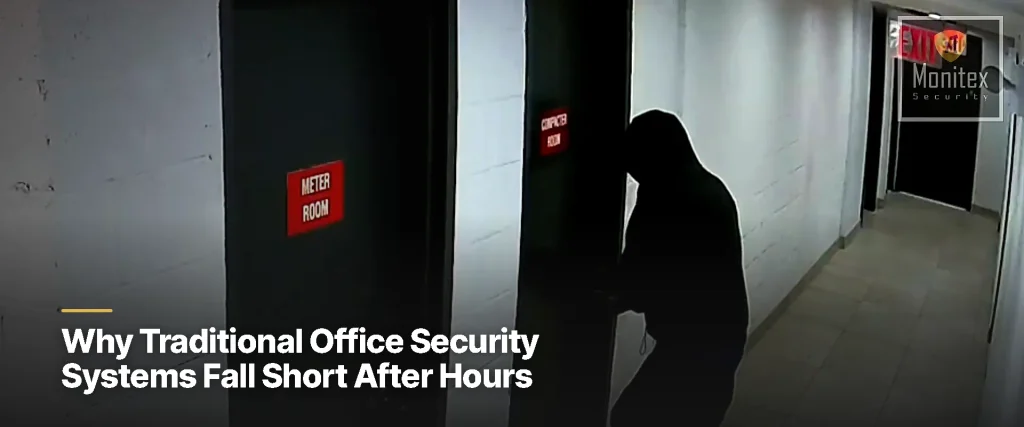
Traditional office security systems (recorded cameras, intrusion alarms and guard patrols) fall short after hours because none of them pairs seeing an event with acting on it while it’s happening. Cameras record with nobody watching, alarms signal without showing what tripped them, and a guard on patrol sees only the area in front of them. Live video monitoring closes the gap by putting trained operators on the cameras in real time.
Key Takeaways
- Most office security systems were built to record or to signal, not to respond, and that matters most when the building is empty.
- Research pooling 40 years of CCTV studies (2019) found that actively monitored camera schemes had larger effects on crime than passive ones.
- Between 94 and 98 percent of police alarm calls are false, and commercial alarm users can see up to three times the false alarm rate of homes.
- A guard on patrol or at a lobby desk covers one spot at a time, while a multi-floor office has many doors.
- Live monitoring adds people who watch, verify and act, and it works alongside the cameras and staff a building already has.
What Office Security Systems Leave Uncovered at Night
Most office buildings run some mix of the same office security systems. There are cameras that record, an intrusion alarm and badge readers on the main doors, and sometimes a guard at the lobby desk or on patrol. During the day, with staff and tenants around, that mix works well enough. Once the last cleaner leaves, the weak spot shows: each system either records or signals, and nobody is in a position to act in the minutes that count.
Below, we look at where each traditional system falls short after hours and what changes with office building live video monitoring, where people watch the cameras as events happen.
If you manage an office property and want to talk through your own setup, Contact for inquiry.
Recorded Cameras: Evidence After the Fact
An office security camera that only records produces evidence, not a response. Footage from an overnight break-in is usually pulled the next morning, once someone notices the damage. By then the intruder is gone, and often the laptops are too.
The research points the same way. A 2019 meta-analysis covering four decades of CCTV evaluations, published in *Criminology & Public Policy*, linked CCTV to a modest drop in crime. It also found that schemes with active monitoring had larger effects than passive systems.
An earlier Urban Institute evaluation of city camera programs (2011) found that cameras began to pay off in Baltimore, where they were maintained and monitored. In Washington, D.C., cameras alone didn’t significantly reduce crime. It’s older, but it remains one of the larger US field studies of how cameras are used.
Recorded footage still matters for police reports, insurance claims and tenant disputes. It just can’t stop anything on its own.
Alarm Systems: A Signal Without a Picture
An office alarm system tells you a sensor tripped. It doesn’t tell you whether that was a burglar, a tenant working late or a cleaner who mistyped the code. That uncertainty is why so few alarm calls lead anywhere.
A police guide on false burglar alarms from Arizona State University’s Center for Problem-Oriented Policing puts the share of false police alarm calls at between 94 and 98 percent.
Offices are especially prone to this. The same guide notes that commercial users can have false alarm rates up to three times higher than residential users. The reason: more people share the job of arming and disarming the system.
Think of a multi-tenant building with early staff, late cleaning crews and weekend contractors, each with a code. The figures come from the early 2000s, so read them as a long-running pattern rather than this year’s count.
So when a sensor trips at night, the next step is a chain of phone calls. The alarm company rings a key holder, who decides whether to drive over, usually without seeing anything. Video alarm verification shortens that chain by letting someone see what set the alarm off.
Guard Patrols and Lobby Desks: One Person, Many Doors
An office security guard brings judgment and a physical presence, which no recording can. The limit is reach. A guard on rounds is on one floor at a time.
An officer at the lobby desk can’t see a rear service door, a roof hatch or the far end of the parking garage. Across several floors, a loading dock and stairwells on every side, most entry points go unwatched between rounds.
Keeping one post filled every hour of the week also takes a rotation of several people. That’s why many owners keep a daytime desk for visitors and deliveries and look for another way to cover nights and weekends. The trade-offs are covered in more depth in our piece on where security guards fall short.
One Break-In, Four Responses
The clearest way to compare office building security systems is to walk one incident through each of them. Say someone pries open a rear service door early on a Sunday morning, around 2 a.m., and heads for the IT room.
| Setup | What it notices | Who finds out | What happens next |
| Recorded cameras only | Records the person coming in | Staff, when they review footage on Monday | A police report after the loss |
| Intrusion alarm | A door sensor trips | The alarm company, then a key holder by phone | Someone decides whether it’s real, usually without seeing anything |
| Guard on patrol | Only what’s on the route at that moment | The guard, if nearby | A response if the guard is close; otherwise found on the next round |
| Live video monitoring | AI flags movement on camera | A trained operator, watching as it happens | A speaker warning, then a call to police with a live description |
The difference isn’t the hardware, since three of the four setups can use the same cameras. It’s whether a person is watching, and able to act, when the door opens.
What Live Monitoring Changes for Office Buildings
Live video monitoring puts trained operators on a building’s cameras in real time. AI flags activity; our operators verify it and respond. When an event is real, the operator speaks to the intruder over on-site speakers, phones police with a description of what is happening, and sends an incident report with timestamped footage afterward.
It doesn’t have to replace what’s already there. We can connect your existing cameras or set up new ones, and monitoring works alongside a lobby desk or a guard.
At one building we were monitoring, a person in a hood worked open a utility room door in a ground-floor hallway late at night. Our operators were watching live and called police, who searched the room and arrested the person (see how that building break-in unfolded). At another, operators saw two people start removing computer equipment from an office and called police, who arrested both (watch the computer theft footage).
For the planning side, such as call lists and when to involve police, our guide to an after-hours security plan for office buildings walks through the steps. The service itself is described on our live video monitoring page.
Put Trained Operators on Your Office Cameras With Monitex Security
Monitex Security monitors commercial properties across the US, with trained operators watching live around the clock. For office buildings, that means:
- Operators who verify every alert before anyone acts
- Live warnings through on-site speakers
- Police calls with real-time details from the cameras
- Incident reports with timestamped footage
- Coverage that works with your existing cameras
Tell us how your building is laid out, which doors worry you and when it sits empty, and we’ll go over coverage with you. Contact for inquiry