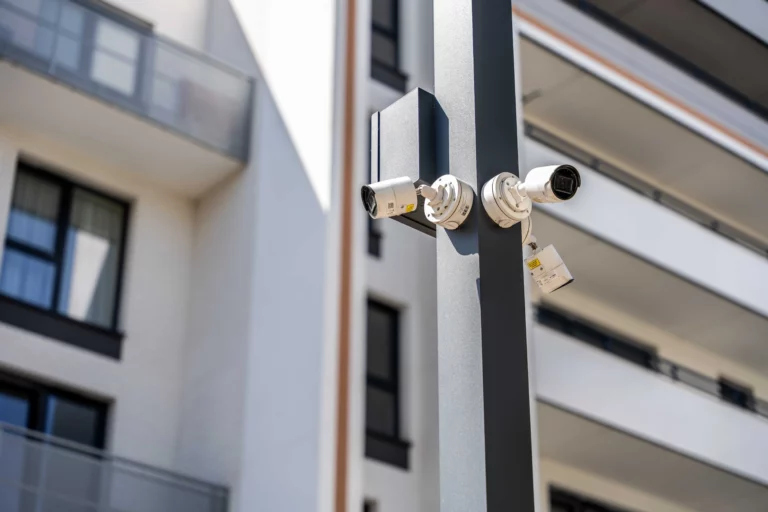
CPTED, short for crime prevention through environmental design, is a way of reducing crime by shaping the physical setting: clear sightlines, defined entrances, visible ownership and good upkeep. It works by making an offender feel more likely to be seen and stopped. Its main principle, natural surveillance, depends on people being there to see, so after hours most CPTED guidance adds cameras or other formal guardians. Research pooling four decades of CCTV evaluations found that cameras someone actively watches cut crime more than recorded-only systems.
Key Takeaways
- CPTED (pronounced “sep-ted”) reduces crime by designing and managing a property so offenders feel watched and unwelcome.
- Four principles appear in almost every guide: natural surveillance, natural access control, territorial reinforcement, and maintenance.
- ISO 22341:2021 sets out international guidelines for CPTED, covering commercial and industrial sites as well as homes and parks.
- Natural surveillance needs people around; at night an empty lot or closed building has none.
- Camera schemes with live, active monitoring, combined with other measures, outperformed passive recording in a 2019 research review (Piza et al.).
Crime Prevention Through Environmental Design, in Plain Terms
CPTED is the practice of arranging and maintaining a property so that crime feels risky to attempt. Instead of relying only on locks and guards, it uses the setting itself: a clear view of the entrance, one obvious way in, a lot that looks cared for. The North Carolina Department of Public Safety calls it “a process, a way of thinking about crime” (NCDPS).
The approach now has an international standard. ISO 22341:2021 gives guidelines for preventing crime and the fear of crime in new or existing built environments. It applies to public and private organizations of any type or size (ISO).
Some states write it into law too. Florida’s Safe Neighborhoods Act defines CPTED as the planned use of natural access control, natural surveillance and territorial reinforcement to reduce criminal opportunity (Fla. Stat. 163.503), one reason the idea comes up in Florida property security planning. Check your state’s rules if a city review asks for a CPTED plan.
For a business owner, CPTED is a cheap first layer: trimmed hedges and re-aimed lights cost little next to a theft claim. It also has a limit, covered further down, and that’s where live video monitoring fits in. If you’re weighing how the two could work together at your site, Contact for inquiry and we can compare notes on your layout.
The 4 CPTED Principles
Guides group CPTED into three to five principles. North Carolina lists three; Seattle Police lists five, adding community activation (Seattle Police Department). These four appear in nearly all of them.
Natural Surveillance
Natural surveillance means designing a space so people can see and be seen. Windows face the parking area, the path to the door is open, and nothing gives cover near an entrance. Seattle’s guidance keeps ground cover under two feet and tree canopies above six feet so sightlines stay clear at eye level. It also warns that poorly aimed lighting can reduce visibility rather than improve it, so a bright floodlight that blinds a camera does more harm than good.
Natural Access Control
Access control steers people toward the entrances you want them to use and away from the ones you don’t. Paths, curbs, fencing, planters and gates make the public route obvious, so anyone outside it stands out. A loading dock with no barrier between the street and the bay doors fails this test, even if the doors themselves are locked.
Territorial Reinforcement
Territorial reinforcement shows where public space ends and private property begins. Fences, signage, paving changes and lighting at the property line tell a visitor that the space belongs to someone. It makes a trespasser’s excuse (“I didn’t know it was private”) harder to use, and it makes legitimate users more likely to notice someone who doesn’t belong.
Maintenance and Image
Upkeep signals that someone is in charge. Seattle’s guidance notes that graffiti, litter and abandoned property suggest less control by place managers and a tolerance of disorder. Fixing a broken light or painting over a tag quickly tells offenders the property is watched, and it keeps camera views clear as well.
Where CPTED Runs Out After Hours
CPTED’s strongest principle depends on witnesses. Natural surveillance works because employees, tenants and passers-by can see what happens. After closing, a business park, a construction site or a dealership lot has almost nobody to do the seeing. The clear sightlines you designed have no one looking down them.
CPTED guidance expects this gap. Seattle’s guidance says that where everyday users can’t keep a place safe, formal guardians such as police or security officers are needed. It also treats cameras as mechanical surveillance that the vegetation plan has to keep clear.
The research supports pairing design with watched cameras. Piza and colleagues pooled four decades of CCTV evaluations in 2019 and found a modest but significant drop in crime overall. Parking facilities showed the strongest and steadiest results, and residential areas saw significant drops too. Systems with active monitoring did better than passive ones, and cameras combined with other measures did better than cameras alone (Piza et al., via the Office of Justice Programs). The authors warned against using CCTV as a stand-alone measure, which is why parking lot monitoring and apartment building security pay off most on a property that’s already designed well.
At a construction site we were monitoring, cameras picked up a person squeezing through the fence at night. Other cameras followed them across the open yard and through the area where materials were stored. Police later searched the site with flashlights and walked a person out (see the fence breach footage). The fence did its access-control job by forcing a slow, visible entry; the cameras and the people watching them did the rest.
How to Run a CPTED Walk-Through of Your Property
A CPTED review starts with what North Carolina calls the 3-D assessment. Designation asks what the space is for; definition asks how ownership, rules and signs mark it out; design asks whether the layout supports that use. Walk the property with those in mind, in daylight and again after dark.
- Stand at the street and look at each entrance. Note every spot where shrubs, dumpsters or parked trailers block the view.
- Check lighting at night: dark gaps along the fence, lights that glare into camera lenses, fixtures that are out.
- Count the ways onto the property. Any route that isn’t an intended entrance needs a fence, gate or barrier.
- Look for signs of neglect: graffiti, piled pallets, broken fencing, overgrown corners.
- Compare camera views with the dark spots and blind corners you found. Foliage and new storage often block views that were clear on day one.
- List the hours the property sits empty. Natural surveillance covers those hours least.
You don’t have to do it alone. NCDPS notes that most law enforcement agencies offer CPTED or security surveys for residential and commercial properties, so your local police crime prevention unit is a good first call. For the physical fixes that follow, our guide to hardening a property against trespassers covers fencing, lighting and signage in more detail.
Add Live Eyes to Your CPTED Plan With Monitex Security
Good design makes intruders easier to spot. Monitex Security makes sure someone is watching when it counts:
- Trained operators watch your camera feeds live around the clock, including the after-hours stretch when natural surveillance is thinnest.
- AI flags activity; our operators verify it and respond.
- Operators speak to intruders through on-site speakers and call police while they’re still there.
- We can connect your existing cameras or set up new ones where your walk-through found gaps.
If your walk-through turned up blind spots you can’t design away, Contact for inquiry and we’ll look at those gaps with you.