
Last updated:
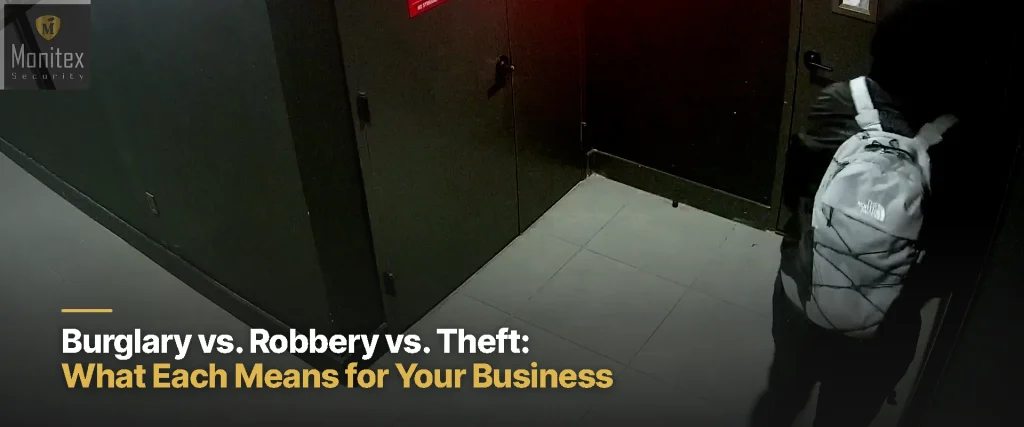
Theft is taking someone else’s property without permission. Burglary is entering a building or other structure unlawfully to commit a theft or another felony, even if nothing ends up taken. Robbery is taking property directly from a person by force, threat or fear. For a business, the difference shows where the risk sits: theft in lots and yards, burglary at doors after hours, and robbery at the counter, where staff safety comes first.
Key Takeaways
- Burglary is about the unlawful entry, robbery is about force against a person, and theft is the taking itself.
- The FBI doesn’t require force for a burglary: in 2019, 37.8% of reported burglaries were unlawful entries with no force at all.
- Robbery is counted as a violent crime because a person is confronted. Burglary and theft are property crimes.
- In 2019, the FBI put the average loss at $2,661 per burglary, $1,797 per robbery and $1,162 per theft.
- Live monitoring helps most with burglary and theft, which tend to happen when no one is on site.
Three Crimes That Sound Alike but Aren’t
Burglary vs robbery is a question of entry versus force. A burglary needs an unlawful entry into a building; a robbery needs a person who is threatened or hurt. Theft, the third term, is the taking of property itself, and it can happen with or without either of the other two.
The words get mixed up in conversation, but police reports, insurance claims and court charges keep them apart. A back door forced overnight and a pallet of copper wire gone is a burglary. Copper wire taken from an open yard with no building entered is usually theft. A clerk handing over the register after being threatened is a robbery.
The labels below follow the FBI’s Uniform Crime Reporting definitions, which police across the country use to report crime. State laws use their own wording and penalty levels, so check your state’s rules for a specific case. Knowing which crime you’re up against also shapes what live video monitoring should watch at your site; to talk yours through, Contact for inquiry.
What Is Theft?
Theft is the unlawful taking of someone else’s property without force against a person. The FBI counts it as larceny-theft: “the unlawful taking, carrying, leading, or riding away of property from the possession or constructive possession of another” (FBI, Larceny-theft).
Larceny vs. Theft
Larceny is the traditional legal name for theft, and the FBI reports the two as one category. Shoplifting, thefts from cars and tools lifted off a truck bed are all larceny-theft. In 2019, shoplifting made up 22.2% of these offenses and thefts from motor vehicles 27.0%, and the average loss was $1,162 per offense (FBI, 2019).
A Monitex case shows how theft looks on camera. At a New York City construction site, two men loaded the site’s road barriers from the curb into a rental truck late at night. No building was entered, so it was theft rather than burglary. Operators watching live called police, the property manager confirmed no one had permission, and both men were arrested (see the case).
Open yards like this are why construction site monitoring focuses on fences, gates and material storage.
What Is Burglary?
Burglary is entering a structure unlawfully to commit a felony or a theft. The FBI is clear that “the use of force to gain entry need not have occurred” (FBI, Burglary). An unlocked side door counts the same as a pried one.
Three details matter for a business:
- Nothing has to be stolen. The crime is complete once someone enters with the intent to commit a crime inside.
- Force is often missing. In 2019, 55.7% of burglaries involved forcible entry, 37.8% were unlawful entries with no force, and 6.5% were attempts.
- Businesses are a real share of the targets. Residential properties made up 62.8% of burglaries in 2019, which leaves 37.2% at nonresidential buildings such as stores, offices and warehouses (FBI, 2019).
This is the main difference in burglary vs theft: burglary is defined by where the person went, not by what they took. Someone who enters without permission and with no plan to commit a crime is usually trespassing instead (what trespassing means for property owners).
In a Monitex case at a client’s building, a person in a hooded jacket came down a stairwell after dark and worked a hallway door open. The monitoring team saw it as it happened and police were sent, and officers walked the suspect out through the lobby (see the building break-in).
What Is Robbery?
Robbery is taking, or trying to take, something of value from a person “by force or threat of force or violence and/or by putting the victim in fear” (FBI, Robbery). The person is the key. Without someone being confronted, it isn’t a robbery.
So theft vs robbery comes down to force, which is also why the FBI lists robbery with violent crimes. In 2019, 16.7% of robberies happened at commercial businesses, 6.6% at convenience stores, 3.0% at gas stations and 1.4% at banks. Among those locations, banks had the highest average loss, $4,213 per robbery (FBI). Reported robberies fell an estimated 18.5% from 2024 to 2025 (FBI, 2026), but the risk sits where cash and staff meet: banks, stores and supermarket checkouts.
Burglary vs. Robbery vs. Theft at a Glance
| Crime | What makes it that crime | Person confronted? | Force needed? | Typical business example |
| Theft (larceny) | Property taken without permission | No | No | Materials taken from an open yard, shoplifting |
| Burglary | Unlawful entry into a structure to commit a crime | No | No | A back door opened overnight and stock removed |
| Robbery | Property taken from a person by force, threat or fear | Yes | Force or threat | A clerk threatened at the register |
What the Difference Means for Your Property
Each crime points to a different place to watch and a different response.
Theft risk sits in the open: lots, yards, loading areas and anything left outside overnight. Cameras there need someone looking at them while it happens, because a recording reviewed the next morning only shows what’s gone.
Burglary risk sits at entry points: back doors, roll-up doors, roof hatches and side entrances that stay quiet after hours. Because so many burglaries involve no force, an unlocked or propped door can be all it takes, with no broken glass to notice later. An operator who sees a person at a door at 2 a.m. can act on what they see.
Robbery is different. Staff are present, and their safety comes first: no confronting the person, and calling police as soon as it’s safe. Monitoring there works as an outside witness that can contact police and keep the footage for the report.
Watch the Doors and Yards Where Burglary and Theft Start With Monitex Security
Monitex Security’s trained operators watch your cameras live, 24/7. AI flags activity; our operators verify it, warn people through on-site speakers and contact police while they’re still on the property. You get a report with timestamped footage for police and insurers, and we can connect the cameras you already have. Tell us about your site and we’ll walk through it with you: Contact for inquiry.