
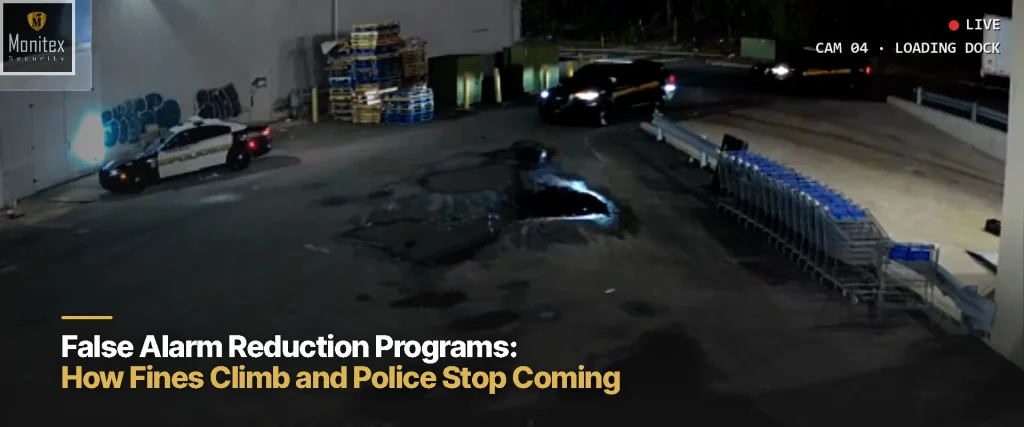
A false alarm reduction program is a city or county system that registers alarm users, allows a few free false alarms a year, then charges rising fines for each one after that. Repeat offenders can lose their permit, and with it police response. Some cities, such as Seattle and Milwaukee, now send officers to burglar alarms only when there’s evidence of a crime, such as video.
Key Takeaways
- Most US false alarm programs follow the same ladder: permit, a few free alarms, rising fines, then suspended or verified-only response.
- Fines differ widely. A permitted business in Dallas pays nothing for its first three false burglar alarms in 12 months, while Los Angeles charges from the first.
- An unpermitted alarm costs more everywhere we checked, and in Dallas it gets no police response at all.
- Since October 1, 2024, Seattle police respond to alarm company calls only with evidence such as audio, video or an eyewitness.
- Most false alarms come from people, not burglars: wrong codes, open doors and untrained staff.
When Your Alarm Comes With a Bill
Nearly every burglar alarm that calls police turns out to be false. The Center for Problem-Oriented Policing’s guide to false burglar alarms put the share at 94 to 98 percent. It also estimated that false alarms make up 10 to 25 percent of all calls to police nationwide.
The guide dates from 2007, but it’s still the standard police reference on the problem. Newer city figures match it: Seattle says more than 98 percent of its burglar alarms prove false.
To recover that time, many cities run a false alarm reduction program. Some call it a false alarm reduction unit; some hand billing to a contractor. For a business, the effect is the same: every false dispatch is counted, and the count decides what you pay and whether officers keep coming.
If you’re weighing live video monitoring services as a way to stop relying on sensor alarms alone, Contact for inquiry and we’ll walk through your property with you.
How a False Alarm Program Escalates
Most programs move a business through the same five steps. Your city may skip one or add its own, so check your local alarm ordinance for the exact rules.
- Permit. You register the alarm with the city and pay a yearly fee. Dallas charges $100 a year for a business permit; Los Angeles charges $45 for a new permit and $26 to renew.
- Free alarms. Many cities forgive the first few false alarms in a 12-month period. Dallas and San Antonio allow three; Phoenix allows one; Los Angeles allows none.
- Rising fines. After the free ones, each false dispatch costs more than the last.
- Revoked response. Too many false alarms, or no permit, and police can stop answering. Houston can revoke a business permit after the seventh false burglar alarm.
- Verified response. In some cities, police don’t come to a burglar alarm until someone confirms a crime. Milwaukee has worked this way since 2004.
False Alarm Fines in Seven US Cities
The fines below come from each city’s own alarm page, checked on November 5, 2026. They’re for false burglar alarms at a permitted site unless noted. Panic and hold-up alarms usually cost more.
| City | Fine schedule (permitted site) | No permit | When police response can stop |
| Los Angeles, CA | $260 per false alarm from the first (rate since May 4, 2026) | $100 penalty added | Permit required to operate an alarm |
| Houston, TX | Business permits: $100 each from the 8th false alarm | $233.50 per alarm | Business permit can be revoked after the 7th false alarm, ending police response |
| San Antonio, TX | 1st–3rd free; 4th–5th $50; 6th–7th $75; 8th and up $100 | $250 per commercial burglar alarm | Police still respond; unpaid fees block a new or renewed permit |
| Dallas, TX | 1st–3rd free; 4th–6th $50; 7th–8th $75; 9th and up $100 | No police response | Police refuse burglar alarm calls from sites without a valid permit |
| Phoenix, AZ | 1st free in 365 days; $96 for each one after | $96 per activation | Not stated on the city page |
| Seattle, WA | $115 each, billed to the alarm company and often passed on; $30 if canceled after dispatch | The alarm company holds the license | Since October 1, 2024, no dispatch on sensor or motion alone |
| Milwaukee, WI | No police fine schedule listed | Not applicable | Since 2004, police respond only after a private responder verifies the alarm |
Here’s what eight false burglar alarms in 12 months would cost a permitted business: $300 in Dallas (plus the $100 permit), $350 in San Antonio and $672 in Phoenix. In Seattle the alarm company is billed $920, which many companies pass on to the customer.
Why Businesses Set Off More False Alarms
Commercial alarms go off by mistake more often than home alarms. The POP Center guide found the business rate can be up to three times the residential rate. More people share the codes, and the systems are more complex.
The guide traces most false burglar alarms to user error. Think of a wrong keypad code, a door left open when the alarm is set, or balloons drifting past a motion sensor. Staff who were never shown how to enter and leave are another common cause.
Bad weather, monitoring-center mistakes and faulty lines cause the rest. In office buildings, cleaning crews and late tenants are the usual trip. At warehouses and self-storage sites, it’s often a dock door that doesn’t fully close.
How to Lower Fines and Keep Police Response
A few habits cut most of the risk. Start with these:
- Keep the permit current. An unpermitted alarm costs $250 per false alarm in San Antonio instead of nothing for the first three, and in Dallas it loses police response.
- Give every key holder their own code, and walk new staff and contractors through arming and disarming.
- Use a closing checklist: doors and windows shut, motion zones clear, HVAC vents not blowing on sensors.
- Have sensors and batteries serviced on a schedule, and replace equipment that trips without cause.
- Ask your alarm company to call you before it calls police. The POP Center guide lists this two-call step among the measures that cut dispatches, and Seattle requires it.
- Use waivers and appeals. In Phoenix, a False Alarm Prevention Program certificate waives one $96 fee. Seattle waives one fee every 84 months for owners who attend an alarm user class within 120 days, and San Antonio takes review requests.
- Track your count. Most programs count over 12 months, so a bad quarter fades if the next one is clean.
Where Video Verification Fits
Video gives police a reason to come, and Seattle shows why. In a September 2024 letter reported by FOX 13 Seattle, the interim police chief counted about 13,000 alarm company burglary calls in 2023. Fewer than 4 percent ended in an arrest or a report.
Seattle now dispatches on alarm calls only with supporting evidence, and Seattle police list audio, video, panic alarms and eyewitnesses as examples.
That changes the question for a business. A sensor tells you a door opened. A camera watched by a person tells you who opened it.
One night at a car dealership we were monitoring, two people walked into the lot and went to the cars. Our operator warned them over the site’s loudspeaker, and they left. When officers arrived, the operator told them the area was clear. You can watch the dealership lot footage.
Video alarm verification explains how alarms are confirmed with video and ranked for police.
Send Police Calls Backed by Live Video With Monitex Security
Monitex Security’s trained monitoring operators watch your cameras live, 24/7. AI flags activity; our operators verify it and respond.
- Someone at a door after hours hears a live warning through your site’s speakers.
- If they stay, our operator calls police and tells them what the camera is showing right now.
- Afterward, you receive an incident report with the timestamped footage.
- Your current cameras can usually be connected, or we can set up new ones.
Contact for inquiry, and we’ll look at your property with you.