Last updated:
Proactive video monitoring is a service in which trained operators watch a property’s cameras live and act while someone is still approaching or on site: a spoken warning through on-site speakers, then a police call if the person stays. Reactive security records the incident for review afterward. Automated “active deterrence” cameras sound a siren or a recorded message but can’t judge who is there or call police. It depends on cameras that cover the approach and written rules for each hour.
Key Takeaways
- Proactive video monitoring means a person watches live and responds during an incident, not after it.
- Recorded cameras give you evidence; automated deterrence gives everyone the same recorded warning; only a live operator can judge, describe and escalate.
- A 2019 review of 76 CCTV studies found larger crime reductions when cameras were actively monitored, with the largest and most consistent effects in car parks.
- Most of what makes monitoring proactive is set up in advance: cameras on the approach, rules by the hour and written escalation steps.
- Proactive monitoring still needs clear night views, power, internet and speakers, and police response times vary by city.
Proactive Video Monitoring Starts at the Fence Line
Proactive video monitoring means a trained operator watches your cameras live and acts while someone is still approaching or on the property. The operator warns the person through a speaker, then calls police if they stay. Reactive security does its work later, when a manager pulls footage the next morning.
The difference is timing. A camera that records a fence climb at 2 a.m. gives you evidence of a loss. An operator who sees the same climb can tell the person to leave before they reach the copper wire, the vehicles or the tool trailer. That is what live video monitoring services are built to do.
Curious where your own cameras would catch someone first? Send us a note through Contact for inquiry and tell us about your fence lines, gates and lot edges.
Reactive, Automated and Proactive Cameras Compared
Security cameras respond in one of three ways, and only one puts a person in charge of the next step while it’s happening.
| System | What happens when someone walks in | Who decides what happens next |
|---|---|---|
| Recorded only (reactive) | Footage is saved, sometimes with a motion alert to a phone | You, usually after the fact |
| Automated deterrence | Analytics trigger a siren, strobe or recorded message | Nobody: the camera follows preset rules |
| Proactive live monitoring | AI flags the person, an operator checks the view, speaks to them and escalates | A trained operator, following your site’s instructions |
Automated deterrence cameras, often sold as “active deterrence”, are a step up from recording. Their limit is that a recording says the same thing to everyone. It can’t tell your cleaning crew from a trespasser, describe what someone is wearing or call police.
A live voice that says “you in the gray hoodie by the gate” is different. It tells the person that someone is watching right now, and it gives police a description if they need to come.
Why Watched Cameras Do More Than Recorded Ones
Crime research keeps finding that cameras do more when someone watches them live. A 40-year review of 76 CCTV studies (Piza, Welsh, Farrington and Thomas, 2019) reported bigger crime drops where someone actively watched the cameras than where footage was only stored. The largest and most consistent effects were in car parks, which is why live monitoring suits parking lots with long rows and few staff at night.
A 2011 Urban Institute evaluation for the Justice Department’s COPS Office points the same way. In Baltimore, trained retired police officers watched the city’s cameras around the clock.
Monthly crime fell by nearly 35% in one neighborhood and 15% in another, with no significant change in a third. Savings from averted crime passed the system’s cost by month 29 (summary by George Mason University’s Center for Evidence-Based Crime Policy).
Those were public cameras linked to police, not private business sites. The lesson still carries over: a camera nobody is watching can’t step in.
The Setup That Makes Monitoring Proactive
Proactive monitoring depends on decisions made before the first alert: where cameras look, what counts as a threat at each hour and what the operator does next. Five pieces matter most.
- Watch the approach, not only the doors. Aim cameras and detection zones at fence lines, gates and the edge of the lot, so an operator sees someone on the way in. Put speakers where people arrive. On construction sites, that means the perimeter fence and the material yard, not just the trailer door.
- Write rules by the hour. List who should be on site and when, such as a cleaning crew until 10 p.m. or a fuel delivery at 5 a.m. Outside those windows, anyone in the yard is a reason to act. Without rules, operators either hesitate on real intruders or warn your own staff.
- Agree on the escalation steps in writing. For example: a first warning, a second warning that names what the person is doing, then a police call and a call to your keyholder. The Monitoring Association is developing TMA-VMS-01, a standard for repeatable decision procedures in monitoring centers that handle video events. Until it’s published, ask to see the written plan for your site.
- Check the night view. Operators can only describe what the camera shows in the dark. Look at each zone at night before monitoring starts and add light where faces and vehicles turn into shadows.
- Review after every incident. A report with timestamped footage shows where the person came in. Use it to move a camera, add a speaker or tighten a rule. In warehouses and self-storage yards with many rows, this is often how blind spots get found.
What a Proactive Response Sounds Like
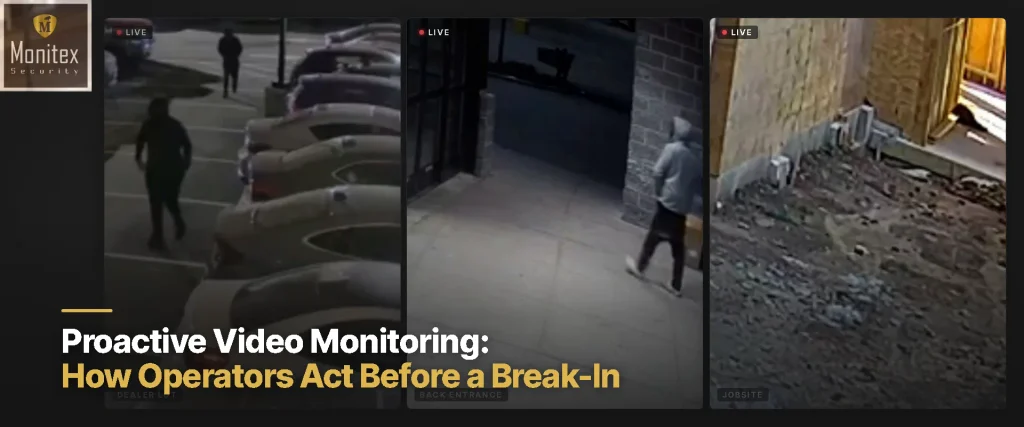
A proactive response takes seconds and starts with a voice. At a car dealership lot we were monitoring, cameras picked up two people walking along a row of parked vehicles at night. Our operator spoke through the on-site speaker: “This is Monitex Security. Hey, you two need to leave the property right now.” Both ran off the lot.
When police arrived, the operator told them over the speaker that the people had left and the area was clear (watch the dealership lot footage). The warning came while the two were still walking between the cars. For car dealerships, that timing is the whole point: inventory sits outside every night, and the response has to start before anyone reaches a vehicle.
Where Proactive Monitoring Has Limits
Proactive monitoring changes when the response starts, but it doesn’t make a property impossible to enter. Knowing its limits helps you set it up well.
- It needs cameras with clear views, plus power and internet at each one, and speakers if operators are going to talk.
- Some people ignore a warning. That’s when the police call matters, and how fast officers arrive depends on the local department.
- It covers watching and responding. Daytime jobs that need hands, like a front desk or badge checks, still need people on site.
If you’re comparing providers, our guide to choosing between remote guarding companies explains how to test a service on your own site before you sign.
Get Proactive Video Monitoring for Your Property With Monitex Security
At Monitex Security, a team of trained operators keeps eyes on client cameras day and night. When AI picks up movement at a fence or gate, an operator confirms what it is, speaks to the person over your site’s speakers and gets police moving if they don’t leave.
Before monitoring starts, we review your entrances, perimeter, blind spots, lighting, hours and contacts, and we can connect your existing cameras. Each incident ends with a written report and timestamped clips, and your site’s instructions can be updated when your hours or entrances change. To talk through your property, Contact for inquiry.