AI remote video monitoring uses video analytics to scan security cameras for people and vehicles in places and hours where they shouldn’t be, then sends those alerts to a monitoring center. The AI is good at noticing movement and sorting it. It can’t judge intent or context, so in human-verified monitoring a trained operator checks each alert, speaks to the person and decides whether to call police.
Key Takeaways
- AI remote video monitoring pairs camera analytics with a monitoring center: the software notices, people decide.
- Analytics are strong at sorting people from vehicles and animals and at watching set zones after hours.
- They still trigger on weather, headlights and wildlife, and they can’t tell a late contractor from an intruder.
- The alarm industry’s ANSI-accredited scoring standard, TMA AVS-01, ranks police calls by confirmed human presence and threat.
- The FTC has said there is no AI exemption from the laws on deceptive claims, so ask any vendor to show its AI working.
- In a human-verified service, an operator warns the person over a speaker and calls police with what they see.
How AI Remote Video Monitoring Works
AI remote video monitoring is a split job. Software watches every camera at once and flags activity that matches the rules you set. A monitoring center then decides what each flag means. The AI does the noticing; a person does the judging.
That split matters because cameras produce far more movement than any team could watch frame by frame. A lot with 20 cameras sees cars, cats, blowing trash and staff all night. Analytics filter that down to the few moments worth a human look.
If you’re comparing live video monitoring services, the first question is what happens after the flag. Contact for inquiry, and we’ll talk through your cameras and the hours you need covered.
What AI Security Camera Monitoring Catches Well
AI security camera monitoring is good at fast, repetitive sorting that tires people out. Most systems can:
- Tell a person from a vehicle or an animal
- Flag anyone crossing a virtual line, such as a fence or a gate
- Watch a zone only during closed hours, like a dealer lot after 9 p.m.
- Time how long someone stays in one spot, which helps spot loitering
- Push the clip to an operator in seconds, with the camera and zone named
On a car dealership lot, that means a person walking between rows at 2 a.m. gets flagged right away, while a stray cat under the same lights usually doesn’t.
Where the AI Gets It Wrong
AI video monitoring still makes three kinds of mistakes: alerts that mean nothing, activity it never sees, and alerts it can’t read.
False alerts come from ordinary things. Rain and snow, headlights sweeping a wall, a tarp flapping on a fence, a deer at the tree line, a spider web in front of the lens. Good tuning cuts these down, but no setting removes them all.
The AI can also miss things. A person far from the camera can be too few pixels to classify. Someone who crawls under a gate or stays in a dark corner may never cross the line the rule watches. A camera aimed into the sun at dawn sees almost nothing.
Tuning and good camera placement narrow these gaps; an operator scanning the live views covers what the rules don’t.
The harder problem is context. The software sees a person in a zone. It doesn’t know that the person is the night cleaner, a contractor finishing late, or a tenant who lost a key.
Nor can it tell whether someone at a fence is leaving or about to climb. Those are judgment calls, and they decide whether police get called.
AI-Only vs Human-Verified Monitoring
Both kinds use AI. The difference is who acts on what it finds.
| Question | AI-only monitoring | Human-verified monitoring |
| Who sees the alert first? | Software, then your phone | A trained operator watching live |
| Who decides it’s real? | You, often hours later | The operator, in real time |
| Who talks to the person? | A recorded message, if any | The operator, about what they’re doing right now |
| Who calls police? | You, if you see the alert | The operator, with a description |
| What do you get after? | A clip | An incident report with timestamped footage |
For how live and automated setups compare beyond the AI itself, see our guide to proactive video monitoring.
Why Police Still Want a Human Call
Police answer many alarms that turn out to be nothing, so a verified call carries more weight. The Monitoring Association’s AVS-01 standard, accredited by ANSI, gives monitoring centers a shared way to score an alarm for unauthorized human activity. Its purpose is to help police set priorities (TMA).
The scale runs from Level 0, no call for service, to Level 4, a confirmed threat to life. Level 2 needs confirmed or highly probable human presence. Level 3 needs a confirmed threat to property.
A motion alert on its own says none of that. Someone has to look.
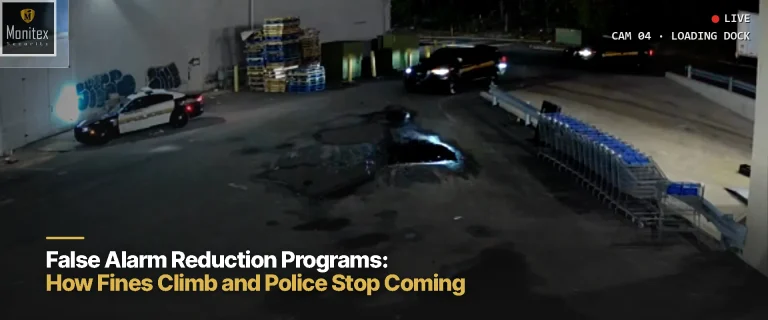
Many cities also fine properties for false alarms, and the fees climb with each one, as our post on false alarm reduction programs explains.
How to Test an AI Monitoring Claim Before You Sign
“AI-powered” isn’t a feature by itself. In 2024 the FTC announced Operation AI Comply, five actions against companies over AI claims. One sold a “robot lawyer” it never tested against a human lawyer. The agency’s chair said there is “no AI exemption from the laws on the books” (FTC).
So ask for proof, not adjectives:
- Show me a real alert from a site like mine, start to finish.
- Who looks at an alert at 3 a.m., and how fast?
- What does the system do on its own, with no person involved?
- Who decides to call police, and what do they tell them?
- What happens to false alerts: are they logged and tuned out?
- Can I see a month of alerts from one site, false ones included?
AI Flags, Operators Decide: One Morning on a Jobsite
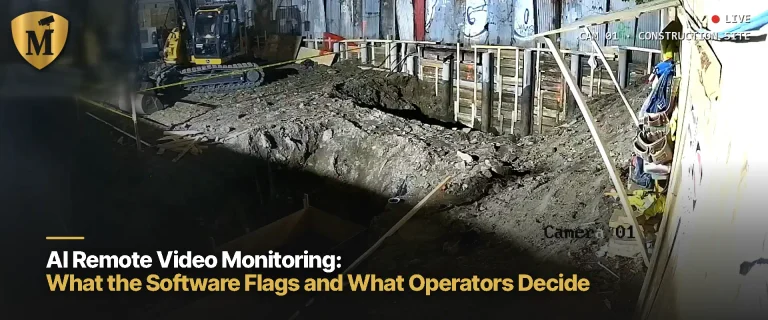
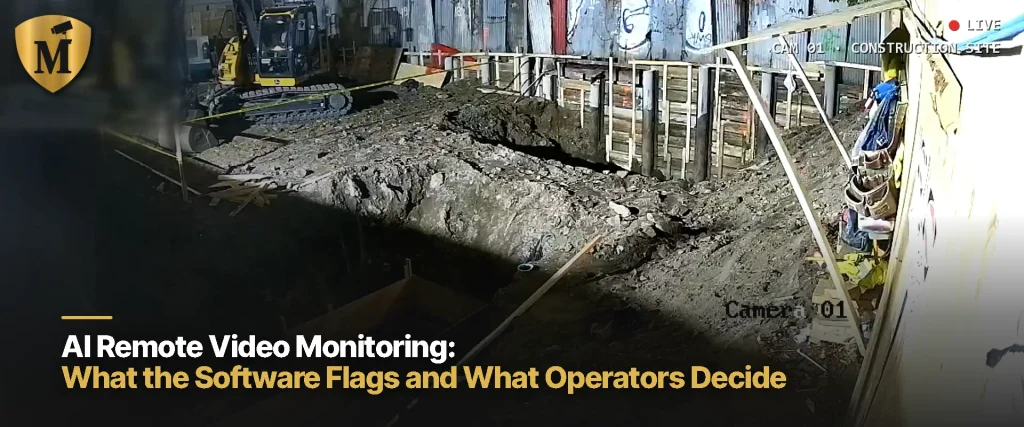
Before sunrise, a camera at a construction site we were monitoring picked up a man climbing the perimeter fence and dropping into the excavation. An operator followed him along the edge of the pit. Rather than wait to see what he was after, the team sounded the site’s horn, then spoke through the speaker: “Stop what you’re doing and get out right now.”
He turned back and climbed out the way he came. Watch the trespasser warned off before sunrise.
CISA makes the same point for detection systems: connect them to a monitoring station so trained people can respond promptly (CISA).
Get AI-Assisted Live Monitoring With Monitex Security
At Monitex Security, AI is a tool our operators use, not a stand-in for them. AI flags activity on your cameras; our trained operators verify it and respond, 24/7. They warn people through on-site speakers, call police with what they see, and send you an incident report with timestamped footage.
If your cameras are compatible, we connect them as they are. Contact for inquiry, and we’ll show you how alerts would be handled on your site.