
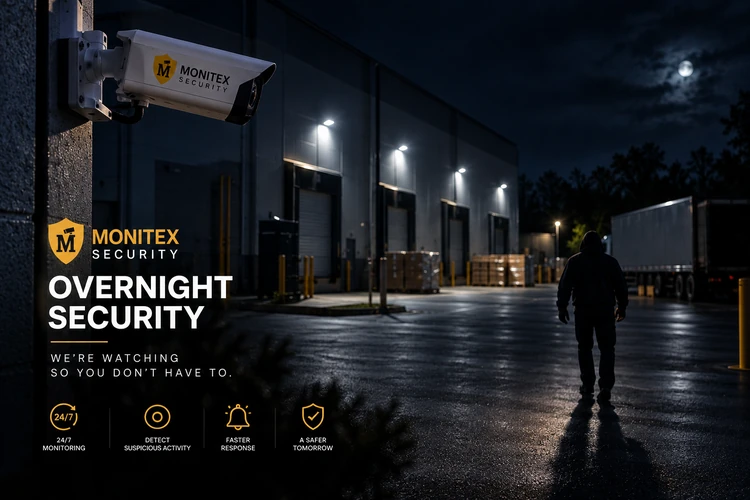
Overnight security refers to the protective measures deployed during nighttime hours to deter, detect, and respond to threats at a property. When the lights go out and foot traffic drops, your facility becomes significantly more vulnerable to break-ins, vandalism, theft, and unauthorized access.
Key Takeaways
- Nighttime hours carry a disproportionately high share of commercial break-ins, making overnight coverage a priority rather than a luxury.
- Technology-driven solutions like remote video monitoring often outperform static guards in both coverage and response speed.
- A layered approach combining cameras, motion sensors, and live monitoring delivers the strongest protection.
- Not every property needs the same solution; the right mix depends on site size, asset value, and risk profile.
- Monitex Security serves properties across New York and nationwide, with tailored overnight protection programs built for real-world conditions.
- Response speed is the single most important factor when evaluating any overnight security provider.
Why Nighttime Is Your Property’s Most Vulnerable Window
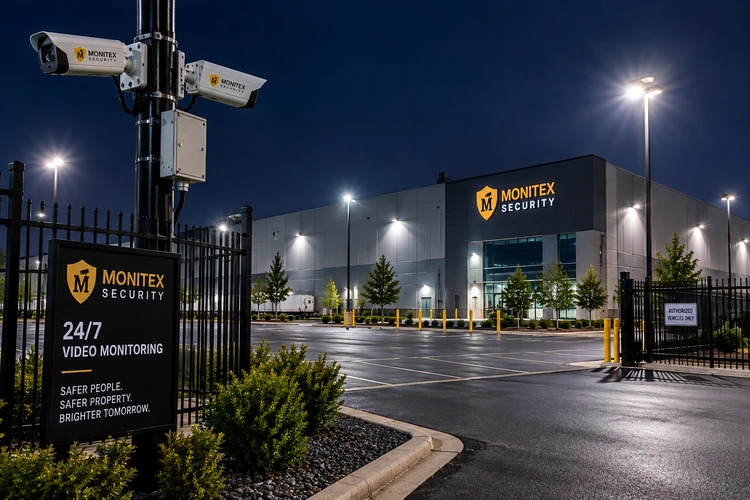
Most commercial break-ins and acts of vandalism happen after business hours. During the day, employees, customers, and foot traffic serve as natural deterrents. Once the building empties and the parking lot clears, that informal layer of protection disappears entirely.
For retail stores, construction sites, warehouses, and multi-family housing complexes, the overnight window carries serious risk. Merchandise, equipment, copper wiring, tools, and sensitive data are all targets. A single incident can result in thousands of dollars in losses, and in some cases, operational downtime that extends far beyond the cost of stolen property.
Property managers and business owners often underestimate this window because incidents happen when no one is watching. That invisibility is exactly what makes overnight security so critical. It fills the gap that daytime operations naturally close.
What makes this window particularly attractive to bad actors is predictability. Most facilities follow the same schedule every night. Locks are set at the same time. Lighting patterns repeat. Patrol routes, if there are any, become familiar. Sophisticated criminals study these patterns before acting. A strong overnight protection strategy disrupts predictability through technology, live human oversight, or both.
Manned Guards vs. Remote Video Monitoring: The Core Trade-Off
For decades, the default answer to overnight protection was a uniformed guard posted at the entrance or walking a patrol route. Guards provide a physical presence that can be reassuring and, in some cases, essential. However, on-site staffing comes with real limitations.
A single guard covers a finite area and cannot monitor multiple zones simultaneously. Fatigue sets in during long overnight shifts. Response to incidents at one end of a property means the other end is temporarily unprotected. Staffing costs are also significant, often running $20 to $45 per hour depending on your market and the certification level required.
Remote video monitoring has emerged as a powerful alternative, and in many scenarios, a complement to manned staffing. With the right camera infrastructure and a live monitoring center in place, trained operators can watch dozens of camera feeds simultaneously, flag suspicious activity in real time, and dispatch law enforcement or on-site response within minutes.
Understanding the benefits of remote monitoring for your security camera system helps you see why technology-driven coverage often outperforms static guard posts when coverage area and response speed are the priorities. The key is combining the right hardware with professional human oversight rather than relying on cameras alone as a passive deterrent.
What a Strong Overnight Security Plan Actually Includes
Effective overnight protection is not a single product or service. It is a layered system where each component reinforces the others. Here is how those layers typically break down:
Perimeter Detection The first line of defense is the perimeter. Motion-activated lighting, fence sensors, and perimeter cameras create an alert the moment someone approaches the boundary. Early detection gives your monitoring team or response personnel time to act before a breach occurs.
High-Definition Camera Coverage Cameras placed at entry points, loading docks, parking areas, and interior corridors form the backbone of any overnight monitoring setup. Resolution matters, as does low-light or infrared capability. A camera that produces a blurry image in the dark provides almost no investigative value after an incident.
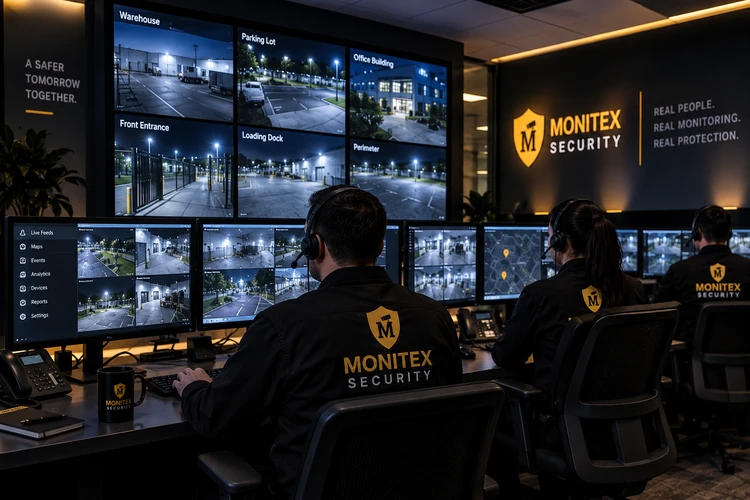
Live Video Monitoring Passive recording is not overnight security in any meaningful sense. Video footage is useful after the fact, but it does not stop anything from happening. Live monitoring means a trained operator is watching feeds in real time and can act the moment something looks wrong. To understand how this works in practice, reviewing the video alarm verification process gives you a clear picture of how alerts are confirmed before dispatch, reducing false alarm costs and speeding up genuine responses.
Audio Deterrents Many modern monitoring setups include two-way audio at camera stations. When an operator spots suspicious behavior, they can issue a live verbal warning through an on-site speaker. This intervention often stops incidents before they escalate, without requiring a physical response at all.
Alarm Integration Motion sensors, door contacts, and glass-break detectors feed into the monitoring center alongside camera feeds. When a sensor triggers, operators immediately pull up the relevant camera view to verify whether the alert is genuine. This is a critical step because unverified alarms clog up emergency dispatch lines and draw fines in many jurisdictions.
| Feature | On-Site Guard | Remote Video Monitoring | Hybrid Approach |
| Coverage area | Limited to patrol zone | Unlimited camera feeds | Broad, with physical backup |
| Response speed | On-site, but zone-limited | Live alert within seconds | Fastest overall |
| Cost per night | High ($160-$360+) | Lower, scalable | Moderate |
| False alarm handling | Manual | Video-verified | Video-verified with escalation |
| Fatigue risk | Yes | No | Reduced |
| Best for | High-value interior assets | Large sites, multiple zones | Critical infrastructure |
How Monitex Security Structures Overnight Protection
Monitex Security was founded in 2019 and has grown to a team of over 200 professionals serving properties across New York and nationwide. The approach is built around the understanding that no two properties share the same risk profile. A downtown retail corridor in Manhattan has entirely different needs than a construction staging site in a suburban industrial park.
Before any overnight security program is deployed, Monitex conducts a thorough site assessment. This covers existing infrastructure, lighting conditions, entry points, prior incident history, and the value of assets on-site. From that baseline, a customized monitoring plan is designed, specifying camera placements, sensor types, patrol requirements if applicable, and escalation protocols.
The monitoring center maintains live coverage through the overnight window, with operators trained to distinguish normal environmental movement from genuine threats. Response protocols are documented and tested before going live so that every person in the chain, from the operator to the responding officer, knows exactly what to do.
For property owners and managers who want to stay informed about security best practices and how emerging technologies are changing overnight protection, the protection insights blog is a strong resource to bookmark.
Choosing the Right Provider: What to Ask Before You Sign
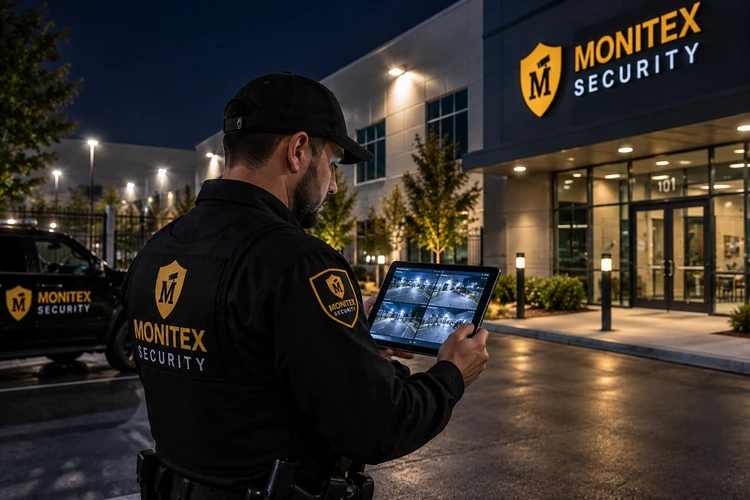
Not all overnight monitoring providers operate the same way. Before committing to a contract, there are specific questions worth asking to separate strong providers from those who simply sell hardware and hope for the best.
How quickly does the monitoring center respond to alerts? Response time from alert to human review should be measured in seconds, not minutes. Ask for documented average response times and whether the monitoring center is staffed 24/7 with dedicated overnight operators or relies on a shared pool.
Is monitoring local or outsourced? Some security companies subcontract their monitoring to third-party centers in other states or countries. This can create communication gaps and slower response. Confirm where your feeds are being watched and who those operators are accountable to.
What happens when a genuine threat is confirmed? The escalation protocol matters. Who gets called first, law enforcement or a site contact? Is there a documented chain of communication? How is the incident logged, and how quickly do you receive a report?
How do they handle false alarms? False alarms are costly and can result in law enforcement de-prioritizing your property over time. A provider using video verification, where an operator visually confirms the alert before dispatching, reduces this risk substantially. You can read more about does remote streaming camera effective for security to understand how camera technology feeds into this verification process.
What is their technology refresh cycle? Security hardware degrades and becomes obsolete. Ask how often cameras, sensors, and software platforms are evaluated and updated. A provider that installed your system in 2019 and has not revisited the hardware since may be leaving you with outdated coverage.
For those interested in joining a team that takes these standards seriously, Monitex is actively growing and posts open positions on the careers page, which reflects the company’s commitment to building skilled overnight monitoring teams.
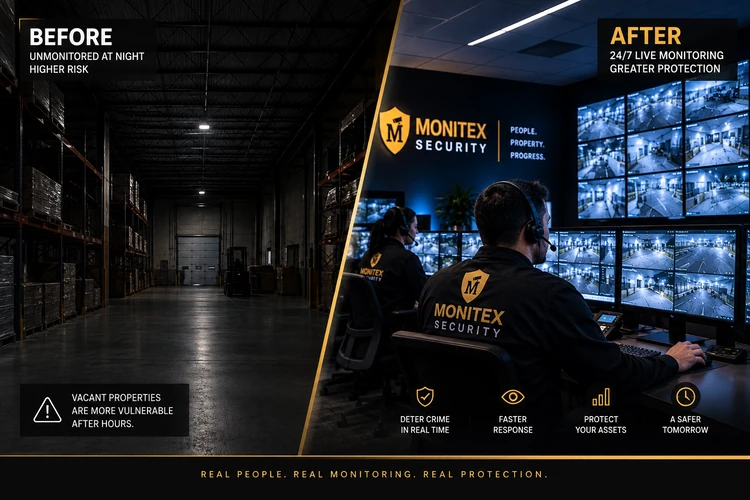
The Real Cost of Going Without Coverage
The financial case for overnight security becomes clear when you account for what a single incident actually costs. A break-in at a commercial property can mean:
- Stolen inventory or equipment valued in the thousands or tens of thousands of dollars.
- Structural damage to doors, windows, and security hardware.
- Business interruption if the site cannot operate the following day.
- Insurance premium increases following a filed claim.
- Reputational impact if the incident becomes public or affects tenant confidence.
Against those potential losses, the monthly cost of a professional monitoring program becomes straightforward math. For most properties, prevention is measurably less expensive than recovery.
Beyond the financial dimension, there is an employee and tenant welfare consideration. People who work in or occupy a building need to trust that the property is protected after hours. That confidence affects retention, lease renewal decisions, and overall satisfaction in ways that are real even if they are harder to quantify.
To learn more about what Monitex Security offers and how the company approaches property protection nationwide, visiting gives you a full picture of available services and the technology behind them.
Overnight Security Across Different Property Types
Different property categories face different overnight risks, and the optimal solution varies accordingly:
Retail and Commercial Storefronts: Smash-and-grab incidents are common. Priority is perimeter detection and rapid law enforcement dispatch. Camera quality at entry points is critical for both deterrence and post-incident identification.
Construction Sites: Equipment and material theft are persistent problems. Sites are typically large with irregular perimeters. Mobile camera units and remote monitoring are often more practical than fixed infrastructure.
Warehouses and Distribution Centers: High-value goods in large, open interior spaces. Internal camera coverage and access point monitoring are equally important. Loading dock activity is a particularly high-risk zone.
Multi-Family Residential: Resident safety and package theft are primary concerns. Parking lot lighting, lobby cameras, and perimeter sensors form the core of the protection stack.
Industrial and Critical Infrastructure: The stakes here are highest. Combining manned presence with full remote video monitoring and environmental sensors provides the redundancy needed.
Each of these categories benefits from a security partner who has worked across multiple property types and can draw on that experience when designing a custom overnight program. Monitex’s team brings that cross-sector experience to every engagement.
Things to Know
- Overnight security is not just about cameras recording footage; passive recording without live monitoring does nothing to prevent an incident in progress.
- Many municipalities in the United States impose fines on property owners for repeated false alarms dispatched to law enforcement, making video verification a financial necessity, not just a convenience.
- Construction sites experience some of the highest rates of overnight theft among commercial property types, largely because they combine high-value equipment with irregular or nonexistent perimeter infrastructure.
- A monitoring contract that does not specify average response times in writing gives you no meaningful accountability if an incident is handled slowly.
- Lighting is one of the most underestimated elements of overnight protection; even the best cameras lose effectiveness in poorly lit environments, and motion-activated lighting alone deters a significant share of opportunistic intrusions.
- Insurance carriers increasingly offer premium reductions for properties with verified, professionally monitored security systems in place, so the investment often pays back through reduced policy costs over time.
Protect Your Property Tonight With Monitex Security
Your property does not get a second chance at the right overnight coverage after an incident has already occurred. Monitex Security works with property owners and facility managers across New York and nationwide to design overnight monitoring programs that are specific to your site, your assets, and your risk level. Every day you go without a verified monitoring plan in place is a window of exposure you do not need to accept.
Contact For Inquiry with the Monitex team today to get a no-obligation site assessment and find out exactly which overnight protection approach fits your property. Call 929-279-4999 or email [email protected] to speak with a security specialist who can walk you through your options and build a program around your schedule and budget.
Frequently Asked Questions
Q: What is the difference between overnight security monitoring and a standard alarm system?
A standard alarm system detects and alerts; overnight security monitoring detects, verifies, and responds.
An alarm system will trigger a siren or send an automated notification when a sensor is tripped, but it does not distinguish between a genuine threat and a false alarm, and it takes no action beyond the alert itself. Overnight monitoring involves live operators who review camera footage in real time, confirm whether a threat is real, and dispatch the appropriate response. This verification step is what separates reactive alerting from genuine overnight protection.
Q: How much does professional overnight security cost for a small commercial property?
Costs vary widely based on property size, camera count, and monitoring requirements, but remote video monitoring is generally more affordable than full-time on-site staffing.
On-site guards typically run $20 to $45 per hour depending on certification level and market, which adds up quickly across an eight-hour overnight shift. Remote monitoring programs through a provider like Monitex are priced based on the scope of the system and the level of coverage required, and they scale more efficiently for properties with large footprints or multiple access points. Requesting a site assessment is the most accurate way to get a real cost estimate for your specific property.
Q: Can remote video monitoring actually stop a crime, or does it only help after the fact?
Remote video monitoring can stop crimes in progress through real-time intervention, including live audio warnings and immediate law enforcement dispatch.
When an operator spots suspicious behavior on a live feed, they can issue a verbal warning through on-site speakers, which frequently causes a would-be intruder to leave without the incident escalating further. If the behavior continues or a breach occurs, the operator dispatches law enforcement with a verified, real-time description of the situation, giving responding officers a significant advantage over responding to an unverified alarm. The goal is always prevention first, with documentation and response as the backup.
Q: What types of properties benefit most from overnight security services?
Any property that holds valuable assets, houses residents, or operates in a high-risk area benefits from overnight coverage, though construction sites, warehouses, and retail locations tend to face the highest overnight risk.
Construction sites are particularly vulnerable because they store expensive equipment in locations that often lack permanent infrastructure. Warehouses and distribution centers hold high-value inventory in large spaces that are difficult to monitor without technology. Retail storefronts face smash-and-grab risks at entry points. Multi-family residential properties deal with parking lot incidents and package theft. Each property type benefits from a customized approach rather than a one-size-fits-all package.
Q: How do I know if my current overnight security setup has gaps I am not aware of?
A professional site assessment conducted by a qualified security provider is the most reliable way to identify blind spots, outdated hardware, and coverage gaps in your current setup.
Many property owners operate with systems that were installed years ago and have never been formally reviewed. Camera blind spots, degraded image quality in low-light conditions, unreliable sensor placement, and outdated escalation protocols are all common findings during a professional assessment. Monitex Security offers site assessments that evaluate your existing infrastructure against your actual risk profile and recommend specific upgrades or adjustments rather than defaulting to a full system replacement.
The Bottom Line on Overnight Security
Protecting your property after hours is not a box to check; it is a continuous operational commitment that requires the right technology, verified monitoring, and a provider who understands your specific site. The nighttime window is predictable, exploitable, and genuinely dangerous for properties that treat overnight coverage as an afterthought. Whether you are managing a single retail storefront, a sprawling construction site, or a multi-building residential complex, a professionally designed overnight security program is one of the highest-return investments you can make in your property’s long-term resilience.
The next step is straightforward. Reach out to Monitex Security at 929-279-4999 or email [email protected] to schedule your site assessment and start building an overnight protection plan that fits your property, your budget, and your schedule.