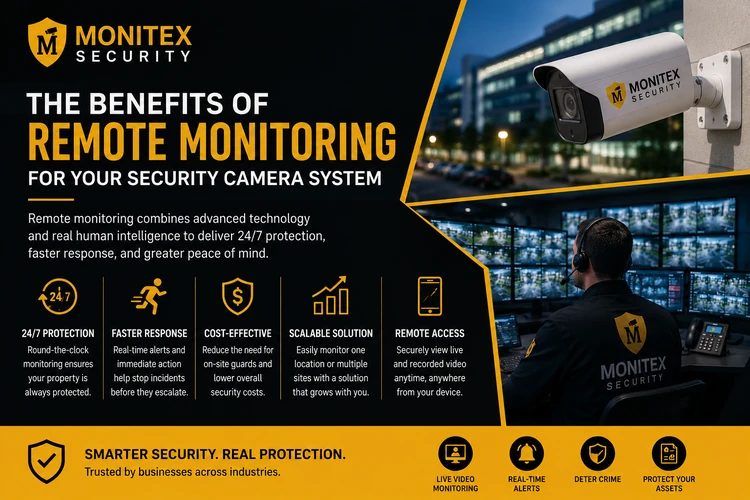
Remote monitoring transforms a passive security camera system into an active, always-on defense layer that works even when you are not on-site. By connecting your cameras to a professional monitoring center or a mobile platform, you gain real-time visibility, faster incident response, and documented evidence that can support law enforcement investigations.
Key Takeaways
- Remote monitoring gives you live access to your cameras from any device, anywhere in the world.
- Professional monitoring centers can verify threats before dispatching police, which cuts down on costly false alarms.
- Monitex Security serves businesses and homeowners across New York and nationwide, offering scalable remote monitoring solutions.
- Construction sites, retail locations, and multi-family properties all see measurable security improvements with remote oversight.
- Integrating remote monitoring with intruder detection systems creates overlapping layers of protection that are significantly harder to defeat.
- Real-time alerts and recorded footage work together to speed up investigations and support insurance claims.
Security threats do not follow business hours. A break-in can happen at 2 a.m. on a holiday weekend, a fire can start in an empty warehouse, and package theft can occur within minutes of a delivery driver leaving your porch. Traditional camera setups record footage for later review, but that reactive approach means damage is already done by the time anyone sees what happened. Remote monitoring flips that dynamic entirely. It puts trained professionals or smart automated systems in the position of watching your property in real time, ready to act the moment something goes wrong.
What Remote Monitoring Actually Means for Your Property
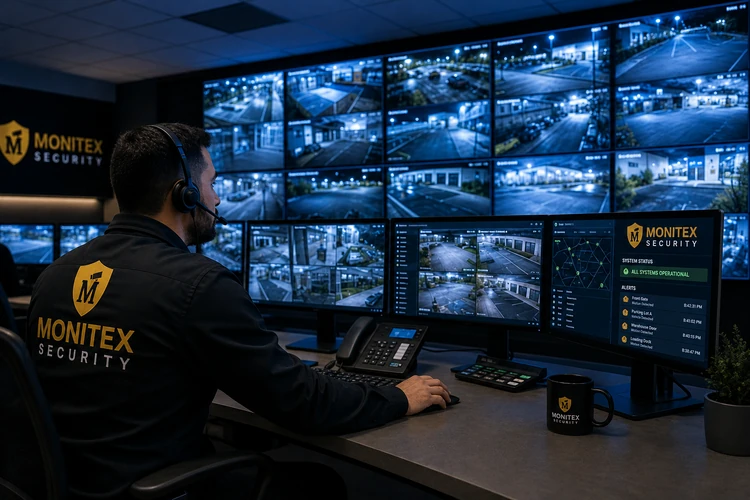
Remote monitoring means that your security camera system is connected to an external platform, a professional operations center, a mobile app, or both, that actively processes what the cameras see. This is different from simply recording footage to a DVR or NVR that you check later. With remote monitoring in place, someone or something is watching in real time and can trigger an alarm, contact you, or notify emergency services based on what the cameras detect.
Monitex Security, founded in 2019 and now operating with a team of over 200 professionals, has built its service model around this principle and operates through to serve clients nationwide. Their approach covers New York and extends to clients nationwide, giving both residential and commercial customers access to centralized, professional-grade oversight regardless of where their property is located. You can reach the team directly at 929-279-4999 or at [email protected] to discuss how a monitored camera setup would fit your specific situation.
For deeper reading on how this integrates with broader security strategy, the protection insights blog offers detailed guidance on topics ranging from perimeter defense to indoor camera placement.
How Real-Time Alerts Change the Response Timeline
One of the most significant advantages tied to the benefits of remote monitoring for your security camera system is the compression of response time. When a camera detects motion, heat, or audio triggers in a monitored setup, an alert fires within seconds. That alert goes to a trained operator, your mobile device, or both simultaneously.
Here is how a typical monitored incident plays out compared to an unmonitored one:
| Scenario | Unmonitored System | Remotely Monitored System |
| Break-in detected | Footage recorded; reviewed next day | Alert fires; operator verifies; police dispatched in minutes |
| Fire or smoke | No alert; damage compounds | Sensor + camera verification; fire department called immediately |
| Package theft | Footage exists but thief is gone | Real-time notification; license plate capture; police notified |
| Trespasser on site | No immediate action possible | Live audio warning issued; escalation if trespasser stays |
| False alarm | N/A | Camera verification prevents unnecessary dispatch |
The video alarm verification process is central to this. Instead of sending police based solely on a motion sensor trigger, a monitoring operator pulls up the camera feed, confirms whether a genuine threat is present, and then decides on the appropriate escalation. This matters because law enforcement agencies in many U.S. jurisdictions have adopted verified alarm response policies, meaning unverified alarms may receive lower priority or result in fines. Verified alarm response programs are documented by the Security Industry Association, which tracks these policies across states.
Remote Monitoring Across Different Property Types
The value of remote monitoring scales depending on the type and size of the property being protected. Below are three common scenarios where the difference becomes especially clear.
Retail and Commercial Spaces
Retail businesses face internal and external theft, liability claims, and after-hours vandalism. Remote monitoring lets operators watch live feeds during closing hours and respond to loitering, break-in attempts, or even employee safety incidents. Some monitoring platforms integrate point-of-sale data with camera footage so that transactions flagged as suspicious can be reviewed immediately.
Residential Properties
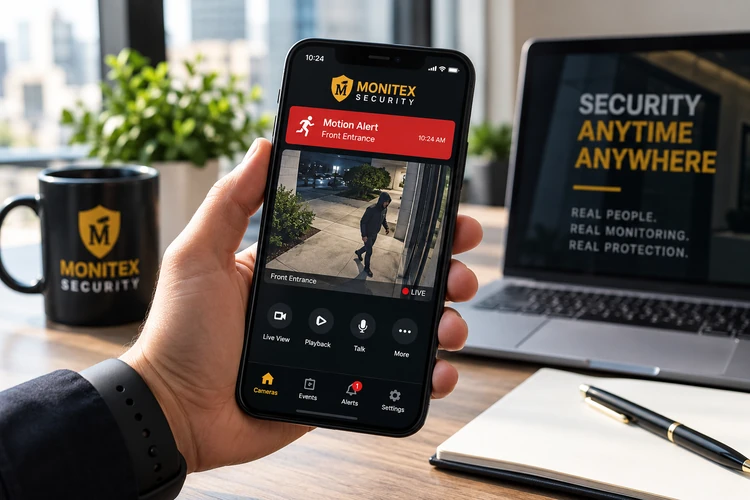
For homeowners, remote monitoring through a smartphone app gives you visibility from anywhere. Whether you are traveling for work, on vacation, or simply away from home for the day, you can check in on your property, receive motion alerts, and confirm whether a delivery arrived safely. Many residential systems also allow two-way audio, so you can speak through a camera-mounted speaker to greet a visitor or deter someone who appears to be casing the property.
Construction Sites
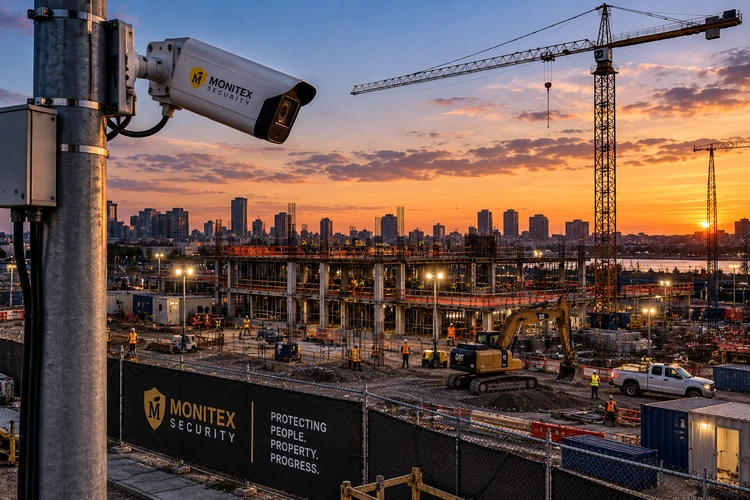
Construction sites are among the most vulnerable property types in the United States. Equipment theft and material theft cost the construction industry hundreds of millions of dollars annually, according to the National Equipment Register and the National Insurance Crime Bureau. After-hours perimeter monitoring is particularly effective here because sites are large, often unfenced at certain boundaries, and contain high-value assets.
The 7 proven strategies to enhance construction site security include remote camera monitoring as a core component, specifically because it allows a centralized team to watch multiple access points simultaneously without the cost of stationing guards at every corner of a large site. For businesses in this sector, monitex security for construction sites surveillance outlines how a tailored monitoring setup can protect equipment, reduce liability, and provide time-stamped evidence in the event of a dispute or injury claim.
The Role of AI and Automation in Modern Remote Monitoring
Modern remote monitoring systems go well beyond a human watching a screen. Artificial intelligence layers have become a standard feature in professionally deployed systems, enabling cameras to distinguish between a person, a vehicle, and an animal. This reduces alert fatigue significantly because the system learns to filter out false triggers like blowing leaves, passing headlights, or small animals.
AI-powered cameras can also perform license plate recognition, track individuals across multiple camera angles within the same property, and flag unusual behavior patterns such as someone spending an extended period near a locked door or emergency exit. The National Institute of Standards and Technology (NIST) has published frameworks on the responsible use of AI in physical security contexts, which is worth reviewing if you manage a facility subject to compliance requirements.
When these smart camera capabilities are paired with intruder detection and deterrence systems, the result is a layered defense that is far more difficult to defeat than any single measure alone. A determined intruder who disables one sensor still faces camera coverage. A camera that is obscured still has a motion sensor backing it up. Layers create redundancy, and redundancy is what keeps properties safe.
Cost Considerations and Return on Investment
One question that comes up consistently when businesses evaluate remote monitoring is whether the monthly cost justifies the expense. The honest answer depends on what you are protecting, but there are several direct and indirect financial benefits to consider.
Direct cost savings:
- Reduced need for on-site security guards, who cost significantly more per hour than a monitoring subscription.
- Lower insurance premiums in many cases, because insurers recognize monitored systems as a higher level of protection.
- Faster police response through verified alarm dispatch, which can limit property damage and theft losses.
- Video evidence that supports insurance claims and avoids protracted disputes.
Indirect benefits:
- Employee and tenant confidence increases when they know the property is actively monitored.
- Liability exposure decreases because documented footage can refute false slip-and-fall or workplace injury claims.
- Operational oversight improves for businesses with multiple locations, since remote monitoring can double as a management tool.
For additional context on how businesses are integrating security technology into risk management strategies, resources like Forbes coverage of commercial security trends and CISA’s physical security resources for businesses offer current, authoritative perspectives.
Setting Up a Remote Monitoring System That Actually Works
Not every camera system is ready for remote monitoring out of the box. The following factors determine whether a setup will deliver reliable, professional-grade results:
- Camera resolution: Footage that is too low in resolution makes it difficult for operators or AI systems to identify faces, license plates, or specific behaviors. A minimum of 1080p is generally considered the baseline for effective remote monitoring.
- Network reliability: Remote monitoring depends on a stable internet connection at the property. A single-point internet failure can create coverage gaps. Many professional installations include cellular backup to ensure continuous connectivity.
- Field of view coverage: Cameras need to be positioned so that all entry points, high-value areas, and perimeter boundaries are visible without significant blind spots.
- Integration with existing systems: A professionally designed system should integrate your cameras, alarm sensors, access control, and monitoring platform into a single, unified dashboard that operators can navigate quickly during an incident.
- Monitoring center certifications: When you work with a third-party monitoring provider, verify that their operations center holds a UL Listing, which is a recognized industry benchmark for central station monitoring quality.
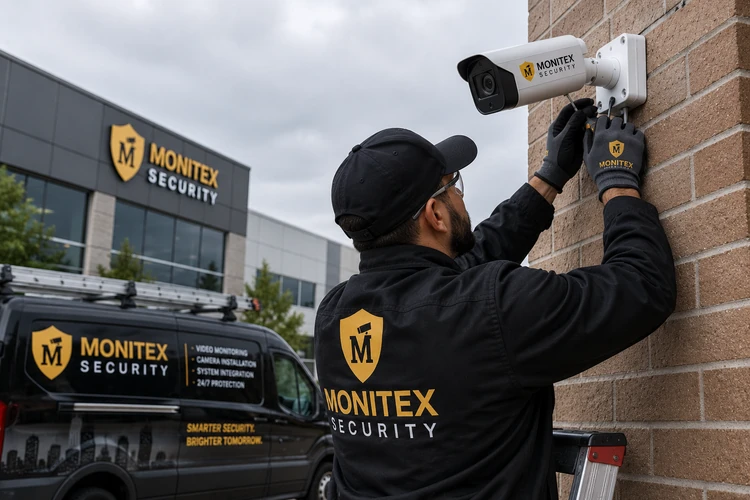
Monitex Security handles the assessment, design, and ongoing support of these systems for clients across New York and beyond. Their team evaluates each property individually to determine the right camera placement, network infrastructure, and monitoring tier before any equipment is installed.
Scalability: Growing Your System Without Starting Over
One of the most practical advantages of modern remote monitoring setups is that they are designed to scale. If you start with six cameras on a single-story retail space and later expand to a second location or add a warehouse, a well-architected system allows you to add cameras and fold the new feeds into the same monitoring dashboard without rebuilding from scratch.
Cloud-based monitoring platforms in particular make this straightforward. New camera locations can be added remotely, firmware updates can be pushed without a technician visit, and storage capacity can be expanded digitally rather than through physical hardware upgrades. For growing businesses, this scalability represents a meaningful long-term cost advantage over systems that require full replacement as needs evolve.
The benefits of remote monitoring for your security camera system are not a one-size-fits-all package. A single-family homeowner needs different features than a multi-site logistics company. What stays consistent across both is the core value: knowing what is happening on your property, in real time, and having a defined response plan ready to execute the moment something goes wrong.
For more information on how Monitex Security structures its monitoring programs, you can visit their comprehensive resources or call the team directly at 929-279-4999.
Things to Know
- Remote monitoring is only as effective as the camera placement supporting it. Even the best monitoring center cannot act on footage that does not clearly capture an incident due to poor angles or insufficient lighting.
- Many U.S. municipalities have adopted verified alarm response policies, meaning police may deprioritize or fine property owners who generate repeated unverified alarms. A monitored system with video verification helps you avoid those penalties.
- Cloud storage and local storage serve different purposes. Cloud storage protects your footage even if equipment is stolen or damaged on-site, while local storage offers faster access without depending on internet bandwidth.
- Not all monitoring centers operate 24/7 with live human operators. When evaluating a provider, confirm whether alerts are handled by trained personnel around the clock or routed through automated systems during overnight hours.
- Cyber security matters as much as physical security for remote monitoring setups. Camera systems connected to the internet should use encrypted connections, strong unique passwords, and regular firmware updates to prevent unauthorized remote access.
- Your monitoring system should be tested regularly. Quarterly drills that simulate a triggered alert, trace the notification path, and confirm operator response times help you identify gaps before a real incident exposes them.
Book a Free Security Assessment with Monitex Today
Your property deserves more than a camera that simply records what already happened. Contact with Monitex Security today and let a professional team design a remote monitoring setup built around your specific property, risk profile, and budget. With over 200 security specialists serving clients across New York and nationwide, Monitex brings the expertise and infrastructure to make your camera system work as an active defense, not just a passive recorder. Call 929-279-4999 or email [email protected] to schedule your free consultation and take the first step toward genuine, around-the-clock protection.
Frequently Asked Questions
Q: How is remote monitoring different from simply viewing my camera app on my phone?
Remote monitoring involves a dedicated professional or automated system actively watching your cameras and responding to incidents, whereas checking your camera app is a passive action you take on your own schedule.
When you view your camera app, you are only seeing footage at the moment you choose to look. Remote monitoring means that trained operators or AI-driven systems are watching continuously, even while you sleep, travel, or focus on running your business. The difference in response time between the two approaches can be the difference between catching a threat in progress and reviewing footage of damage that has already occurred.
Q: Will remote monitoring reduce my business insurance premiums?
Many commercial insurers offer premium reductions for properties with professionally monitored security camera systems, though the exact discount varies by insurer, policy type, and the level of monitoring in place.
You should contact your insurance provider directly to ask about any credits or discounts tied to verified monitoring services. Providing documentation from your monitoring provider, such as a UL-listed central station certificate, typically strengthens your case when negotiating coverage terms. Some businesses report meaningful annual savings that partially offset the cost of the monitoring subscription itself.
Q: Can remote monitoring work for a property with an unreliable internet connection?
Yes, professional remote monitoring installations typically include cellular backup systems that maintain connectivity even when a primary internet connection fails.
This is a critical consideration for rural properties, construction sites, and older commercial buildings where wired internet infrastructure may be inconsistent. A dual-path setup, using both broadband and cellular, ensures that a cut cable or router failure does not create a window of unmonitored vulnerability. Monitex Security evaluates network infrastructure as part of every site assessment so that connectivity gaps are addressed before the system goes live.
Q: How many cameras do I need for effective remote monitoring to work?
The number of cameras depends entirely on the size, layout, and risk profile of your property, but the goal is to eliminate blind spots at all entry points, perimeter boundaries, and high-value areas.
A small retail storefront may be well covered by four to six cameras, while a large construction site or warehouse complex may require dozens positioned across multiple zones. During a professional site assessment, a security specialist will map your property, identify the highest-risk areas, and recommend a camera count and placement strategy that provides complete, overlapping coverage without unnecessary redundancy. Quality of placement matters more than sheer quantity.
Q: What happens if a camera goes offline during a monitored incident?
A professionally managed remote monitoring system will flag any camera that goes offline and can escalate the situation based on the last captured footage and any supporting sensor data from the surrounding area.
Most enterprise-grade monitoring platforms include health monitoring for every device in the network. If a camera drops off unexpectedly, especially during an active alert, the monitoring center treats that as a potential threat indicator rather than a routine technical glitch. Operators can then cross-reference adjacent cameras, trigger on-site audio warnings, or dispatch a response team depending on the escalation protocol established for your property.
The Bottom Line on the Benefits of Remote Monitoring for Your Security Camera System
The benefits of remote monitoring for your security camera system come down to one core shift in how security actually functions: from reactive to proactive. Recording footage is useful, but having trained professionals and intelligent systems actively watching your property, verifying threats, and coordinating responses in real time is an entirely different level of protection. Whether you manage a single-family home, a retail chain, or a large construction site, the gap between a monitored and an unmonitored system becomes most apparent precisely when it matters most.
Monitex Security has been building and managing these systems since 2019, working with clients across New York and throughout the United States to ensure that their cameras do more than record. If you are ready to move from passive footage collection to active, professional-grade oversight, call 929-279-4999, email [email protected], or visit the Monitex website to start the conversation. A free assessment is the logical next step.