
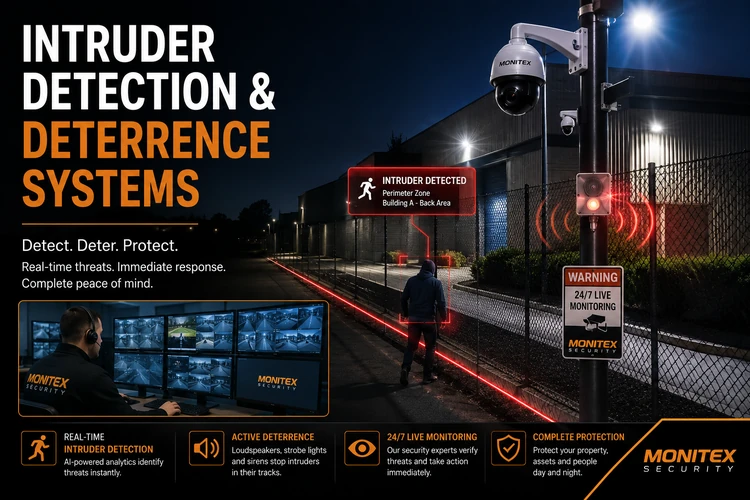
Intruder detection & deterrence systems are integrated security solutions designed to identify unauthorized access and actively discourage criminal activity before it escalates. When properly deployed, they combine sensors, cameras, monitoring, and response protocols into a layered defense that protects both residential and commercial properties.
Key Takeaways
- Effective security requires both detection and deterrence working together, not just one or the other.
- Motion sensors, access control, video surveillance, and professional monitoring are the four pillars of a complete system.
- Visible deterrents such as cameras and signage reduce the likelihood of an intrusion attempt before it begins.
- Remote monitoring adds a human layer of response that automated systems alone cannot replicate.
- Tailored assessments matter: a retail storefront has different vulnerabilities than a warehouse or a private residence.
- Partnering with a licensed, experienced provider is the most reliable path to a system that actually performs under pressure.
Why Detection Alone Is Not Enough
Many property owners make the mistake of treating security as a single-layer problem. They install an alarm and assume the job is done. In practice, detection without deterrence leaves a critical gap: the system alerts you that something happened, but it does nothing to prevent the attempt in the first place.
Research from the Bureau of Justice Statistics consistently shows that most burglars are opportunistic. They assess risk before committing. A property that signals robust security through visible cameras, motion-activated lighting, and monitored alarm signage is far less likely to be targeted than one that appears passive or unattended.
This is why the most effective approach stacks multiple layers. Detection technologies identify threats the moment they appear. Deterrence technologies push would-be intruders to reconsider before they ever act. Together, they address the full timeline of a security event: before, during, and after.
The Core Components of a Modern System
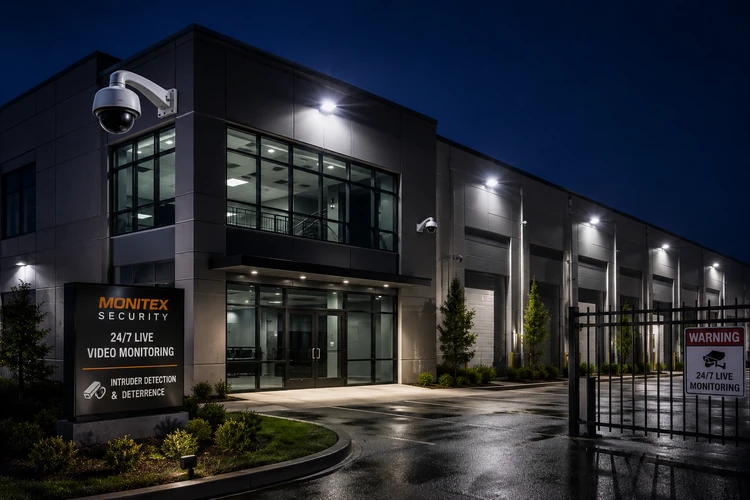
Understanding how intruder detection & deterrence systems are built helps you make smarter decisions about what your specific property needs. Most professional-grade systems draw from the following categories of technology.
Perimeter and Entry Sensors
Door and window contact sensors are the baseline. When a door opens unexpectedly or a window breaks, the sensor triggers an alert. Glass-break detectors add an acoustic layer, picking up the specific frequency of shattering glass even when a sensor-equipped window is not physically opened.
Passive infrared (PIR) motion sensors detect changes in heat signatures as a person moves through a space. Combined with microwave sensors in dual-technology detectors, false alarms drop significantly, which matters for both homeowners and businesses tired of being disrupted by non-events.
Video Surveillance and Motion-Tracking Cameras
Modern cameras do far more than record. AI-powered analytics can distinguish between a person, a vehicle, and an animal, reducing the noise that basic motion detectors create. For businesses especially, the advantage of motion tracking security camera for business extends beyond theft prevention to include employee safety, liability documentation, and operational oversight.
High-definition cameras with night vision and wide dynamic range ensure usable footage in low-light and high-contrast conditions, like a parking lot with direct sunlight on one side and deep shadow on the other. Strategically placed cameras also serve a deterrence function. Studies cited by the National Institute of Justice have found that surveillance camera programs in high-crime areas contribute to measurable reductions in property crime.
Access Control Systems
Keycard readers, PIN pads, biometric scanners, and smart locks all fall under access control. These systems limit who can enter specific areas and create an audit trail of every access event. For commercial properties, this is invaluable: you know exactly who entered the server room at 2 a.m., and you can revoke access instantly if an employee is terminated.
Residential applications are growing too. Smart locks that integrate with mobile apps allow homeowners to grant temporary access to service workers, check entry logs, and lock or unlock remotely.
Professional Alarm Monitoring
A system that alerts only the property owner has a single point of failure: you. Professional alarm monitoring solves this by routing alerts to a staffed monitoring center 24 hours a day, seven days a week. Trained operators assess the situation, contact you, and dispatch emergency services when warranted.
This matters more than many people realize. If you are traveling, asleep, or in a situation where you cannot respond to an alert, professional monitoring ensures continuity of response. The Electronic Security Association estimates that monitored alarm systems are significantly more effective at resulting in law enforcement response than unmonitored ones.
How Remote Monitoring Raises the Bar
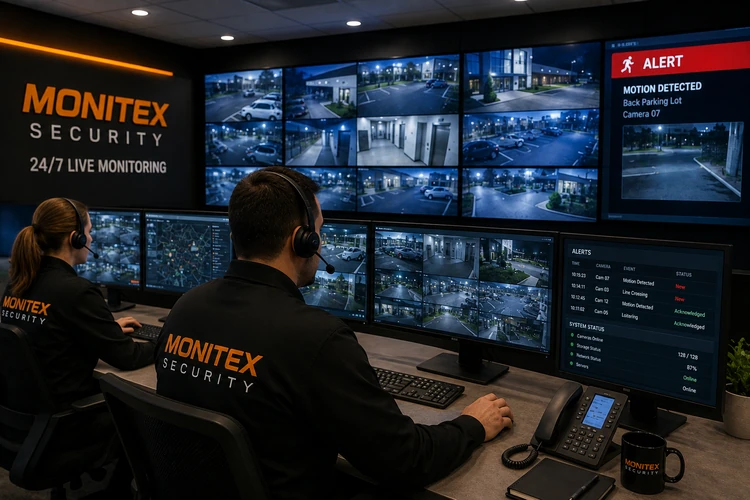
One of the most significant advances in modern security is remote video surveillance with live human oversight. Rather than simply recording footage for review after the fact, remote monitoring allows trained security professionals to watch feeds in real time, identify suspicious behavior, and intervene before an incident escalates.
To understand how this process actually works, reviewing how the remote video surveillance systems process functions in practice clarifies the value it delivers. When a camera detects movement after hours, an operator reviews the live feed within seconds. If the activity is suspicious, they can trigger an audio warning through a speaker system on-site, alerting the potential intruder that they are being watched. Simultaneously, they can notify law enforcement and the property owner.
This shifts the security equation dramatically. Instead of discovering a break-in the next morning and filing a police report, you have a proactive system that interrupts the crime in progress. For retail businesses, warehouses, construction sites, and multi-family residential properties, this capability is particularly valuable.
Choosing the Right System for Your Property Type
Not every property has the same threat profile, and not every budget is the same. The right system for a two-bedroom apartment looks very different from what a 50,000-square-foot distribution center requires.
| Property Type | Key Priorities | Recommended Components |
| Single-family home | Entry detection, fast response | Door/window sensors, indoor cameras, professional monitoring |
| Retail storefront | Theft deterrence, liability documentation | PTZ cameras, motion analytics, access control, alarm monitoring |
| Office building | After-hours coverage, access logging | Access control, perimeter sensors, remote monitoring |
| Warehouse/industrial | Perimeter defense, large-area coverage | Outdoor cameras, motion lighting, fence detection, remote monitoring |
| Multi-family residential | Common area safety, package theft | Lobby access control, hallway cameras, intercom integration |
The table above is a starting framework. A proper security assessment from a licensed provider will account for your specific layout, existing infrastructure, local crime patterns, and compliance requirements.
What a Professional Assessment Covers
A qualified security firm will walk your property and evaluate:
- All potential entry and exit points
- Existing lighting conditions and blind spots
- Current security hardware and its condition
- Response time benchmarks for local law enforcement
- Any industry-specific compliance requirements (such as those relevant to healthcare or financial services)
This assessment forms the foundation of a system design that is neither over-engineered nor under-equipped.
Common Mistakes That Undermine Security Systems
Even well-intentioned security setups fail when common errors are made during planning or installation.
Inadequate lighting: Cameras are only as useful as the light available to them. Dark perimeters are a liability. Motion-activated floodlights are a low-cost, high-impact addition that improves both detection accuracy and deterrence.
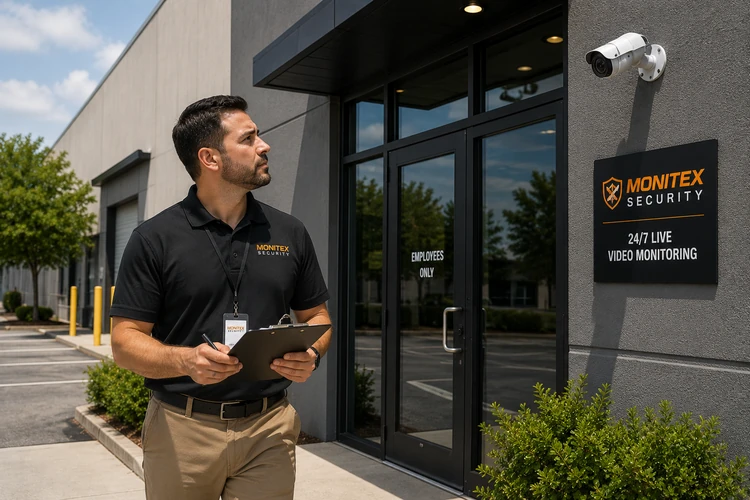
Poor camera placement: Cameras aimed at the sky, angled incorrectly, or obstructed by foliage provide little value. Camera positioning should be validated by a professional who understands both field of view and legal considerations around surveillance in the United States.
No redundancy in communication: Many alarm systems communicate via a single cellular or internet channel. If that connection is disrupted, intentionally or otherwise, the alarm cannot report. Dual-path communication (cellular plus broadband, for example) eliminates this vulnerability.
Deferred maintenance: Sensors drift, camera lenses accumulate dust, and batteries fail. A system that was excellent when installed can degrade quietly over months. Scheduled maintenance agreements with your security provider prevent silent failures.
Over-relying on DIY systems: Consumer-grade equipment from big-box retailers has a place in low-risk residential settings, but it rarely scales effectively. Commercial properties and high-value residences need equipment built to professional standards with the monitoring infrastructure to match. Resources like the protection insights blog cover many of these nuances in depth, making it a useful reference as you evaluate your options.
How Monitex Security Approaches System Design
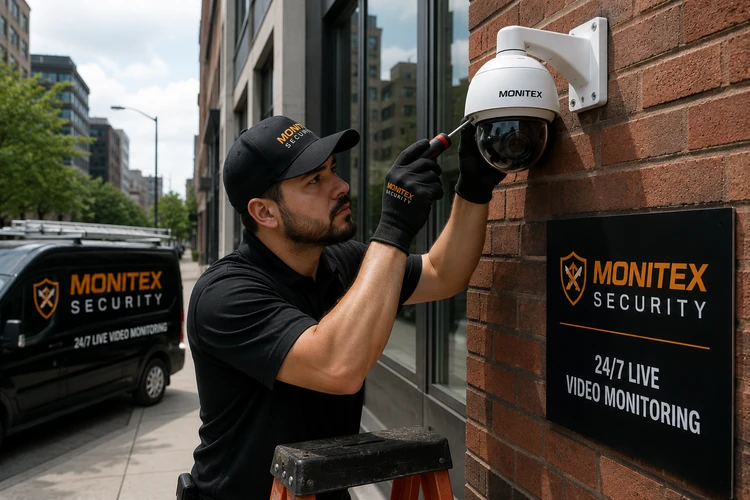
Monitex Security, founded in 2019 and now serving clients across New York and nationwide, brings a team of more than 200 security professionals to every engagement. The company’s approach centers on understanding each client’s specific risk profile before recommending any technology.
Rather than selling a package, Monitex conducts property-specific assessments, designs integrated systems, and provides ongoing monitoring and support. This matters because intruder detection & deterrence systems are not one-size-fits-all products. They are engineered solutions, and the quality of the engineering determines the quality of the protection.
For clients who want to understand what professional security actually involves before making a commitment, provides an overview of service offerings, methodology, and coverage areas.
The company can be reached directly at 929-279-4999 or [email protected] to discuss your property’s needs.
The Legal Framework Around Security Systems in the United States
Security systems in the U.S. operate within a patchwork of federal, state, and local regulations. Several points deserve attention:
Permit requirements: Many municipalities require a permit before installing a monitored alarm system. Some jurisdictions also require registration with local law enforcement. Failure to comply can result in fines and, in some areas, law enforcement may decline to respond to repeat false alarm addresses.
Privacy and surveillance laws: Recording video on your own property is generally permissible, but audio recording carries stricter rules under the Electronic Communications Privacy Act and various state wiretapping statutes. In states like California, New York, and Illinois, two-party consent for audio recording applies in certain contexts.
Alarm response fees: Some cities, including New York City, charge property owners fees after repeated false alarm dispatches. A well-designed system with minimal false alarms protects you financially as well as physically.
Consulting with both a security professional and, if needed, a local attorney ensures your system is both effective and compliant. The Federal Communications Commission also publishes guidance relevant to wireless-enabled security devices.
Integrating Your System: The Role of Smart Technology
Modern intruder detection & deterrence systems increasingly integrate with broader smart building or smart home platforms. Devices that once operated in silos, cameras, sensors, locks, and lighting, now communicate through unified dashboards accessible via smartphone or desktop.
This integration delivers real-time awareness regardless of where you are. A warehouse manager in Chicago can check live camera feeds at a facility in Queens. A homeowner traveling internationally can lock a door left open accidentally or see who rang the doorbell at midnight.
Integration also enables automation. Sensors can trigger lights, cameras can initiate recording and alert sequences simultaneously, and access control events can generate immediate notifications. The system becomes proactive rather than reactive, which is the defining characteristic of modern security architecture.
When evaluating integrated platforms, prioritize those that offer encrypted communications, regular firmware updates, and compatibility with third-party devices. A platform that locks you into proprietary hardware limits your ability to upgrade or expand as your needs evolve.
To move forward with a customized assessment of your property’s security needs, reach out through the contact page or call 929-279-4999 directly. The Monitex Security team is available to review your situation and recommend a system built around your actual risk profile, not a generic template.
Things to Know
- Most insurance providers in the United States offer discounts on homeowner or commercial property premiums when a professionally monitored alarm system is installed, so your security investment may partially offset itself over time.
- A system’s weakest point is usually the one that was never assessed: side entrances, roof hatches, basement windows, and loading dock doors are frequently overlooked during basic security planning.
- False alarms are one of the most common reasons property owners disengage their systems or stop taking alerts seriously. Choosing dual-technology sensors and scheduling regular maintenance dramatically reduces false alarm rates.
- Many jurisdictions in New York and across the U.S. require alarm system permits before installation. Operating without one can result in fines and may affect law enforcement response priority.
- Wireless systems offer faster installation and greater flexibility, but they depend on battery health and signal reliability. Wired systems are more stable but harder to expand. Many professional installations use a hybrid of both.
- Video footage from your security cameras may be requested by law enforcement during an investigation, and some insurers require documented footage as part of a loss claim. Knowing your storage retention settings before an incident occurs is critical.
Protect Your Property Before an Incident Forces Your Hand
Your security gaps exist right now, whether or not you are aware of them. A professionally designed intruder detection and deterrence setup closes those gaps before a criminal finds them first. Monitex Security works with property owners across New York and nationwide to build systems that are engineered around your specific vulnerabilities, not copied from a catalog. contact today and speak directly with a security professional who will assess your property, answer your questions, and recommend a solution that fits your risk profile and budget. Call 929-279-4999 or email [email protected] to schedule your free expert consultation now.
Frequently Asked Questions
Q: What is the difference between a detection system and a deterrence system?
A detection system identifies that an intrusion is occurring or has occurred, while a deterrence system discourages an intruder from attempting entry in the first place.
Detection components include motion sensors, door contacts, and alarm triggers that activate once a threat is present. Deterrence components include visible cameras, motion-activated lighting, audio warning speakers, and alarm signage that signal to a potential intruder that the property is monitored and the risk of being caught is high. The most effective security setups combine both functions rather than relying on either one alone.
Q: How much does a professionally installed intruder detection and deterrence system cost?
Costs vary widely depending on property size, component selection, and whether professional monitoring is included, but most commercial installations in the U.S. range from a few thousand dollars to well above $20,000 for large or complex facilities.
Residential systems are generally less expensive, with basic professionally monitored setups starting around $500 to $1,500 for equipment plus installation, followed by monthly monitoring fees typically ranging from $25 to $60 per month. The best way to get an accurate figure is through a site-specific assessment, since blanket pricing rarely reflects the real requirements of your property. Monitex Security provides consultations at 929-279-4999 to help you understand what a properly designed system would cost for your specific situation.
Q: Can I monitor my security system remotely, and is it secure?
Yes, most modern professionally installed systems offer remote access through encrypted mobile apps or web dashboards, allowing you to view live feeds, receive alerts, and control access points from anywhere.
Security of the remote access platform itself depends heavily on the provider. You should look for systems that use end-to-end encryption, require two-factor authentication for login, and receive regular firmware updates. Avoid platforms that store footage on unprotected cloud servers or that have not disclosed their data security practices. A reputable provider will be transparent about how your data is stored and who can access it.
Q: How do I know if my current security system is still adequate?
If your system has not been professionally assessed in the past two to three years, or if your property use has changed significantly since installation, it is likely overdue for a review.
Common signs that a system is no longer adequate include frequent false alarms, outdated camera resolution that produces unclear footage, sensors that have never been tested, and coverage gaps created by renovations or new entry points. Technology also evolves quickly. A system installed five years ago may lack the analytics, integration capabilities, and communication redundancy that current professional standards recommend. A licensed security provider can walk your property and identify gaps without requiring you to commit to a full replacement immediately.
Q: Are there security system requirements specific to businesses in New York?
New York City and New York State have specific permit, registration, and false alarm ordinances that businesses must comply with when operating monitored alarm systems.
In New York City, the Police Department requires alarm system registration, and repeat false alarms can result in escalating fines and reduced law enforcement response priority. Some commercial property types, including those in healthcare or financial services, may also face industry-specific compliance requirements that intersect with physical security. Working with a security provider that operates in New York and understands the local regulatory landscape, as Monitex Security does, ensures your system is compliant from day one rather than corrected after a violation.
The Bottom Line on Intruder Detection & Deterrence Systems
Security is not a product you buy once and forget. Intruder detection & deterrence systems are living infrastructure that need to be designed thoughtfully, installed correctly, maintained consistently, and updated as both your property and the threat environment change. The properties that suffer the fewest incidents are almost always the ones whose owners treated security as an ongoing priority rather than a one-time purchase.
If you are ready to move from passive concern to active protection, the next step is straightforward. Reach out to Monitex Security at 929-279-4999, email [email protected], or visit the contact page to request your free expert consultation. A trained security professional will assess your property, identify your actual vulnerabilities, and build a system designed to address them, so you know exactly what you have and why it works.