
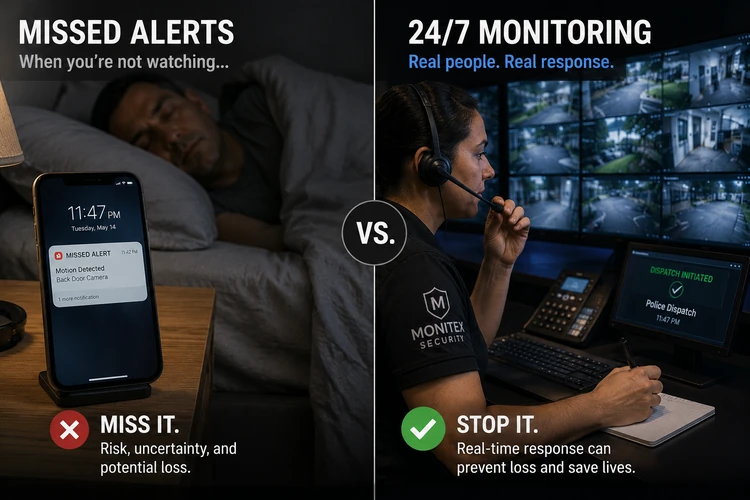
Professional alarm monitoring is a service where a licensed central monitoring center watches over your security system around the clock and dispatches emergency services when an alarm triggers. Unlike self-monitoring, where you are solely responsible for checking alerts on your phone and calling 911 yourself, a professional monitoring team handles that entire response chain on your behalf, even when you are unavailable, asleep, or out of cell range.
Key Takeaways
- Professional monitoring centers operate 24/7/365, providing a response layer that self-monitoring cannot replicate.
- Monitored alarm systems can reduce police response times because dispatch comes from a verified, recognized source.
- Monthly monitoring fees in the U.S. typically range from $15 to $60, with no-contract options widely available.
- Having a professionally monitored system can lower your homeowners or renters insurance premium by up to 20%.
- Camera verification features are rapidly replacing simple trip-wire alerts, cutting false dispatches significantly.
- Choosing the right monitoring provider depends on your property type, contract terms, and the technology behind the service.
Why Professional Alarm Monitoring Exists and What Problem It Solves
The core problem that professional alarm monitoring addresses is the gap between when a security event happens and when someone with authority to help actually responds. The average American home burglar spends fewer than 10 minutes inside a property, according to the FBI’s crime statistics data. In that narrow window, a self-monitored system that sends you a push notification only works if you see it, interpret it correctly, call 911, provide your address, and wait for dispatch. Every one of those steps costs time.
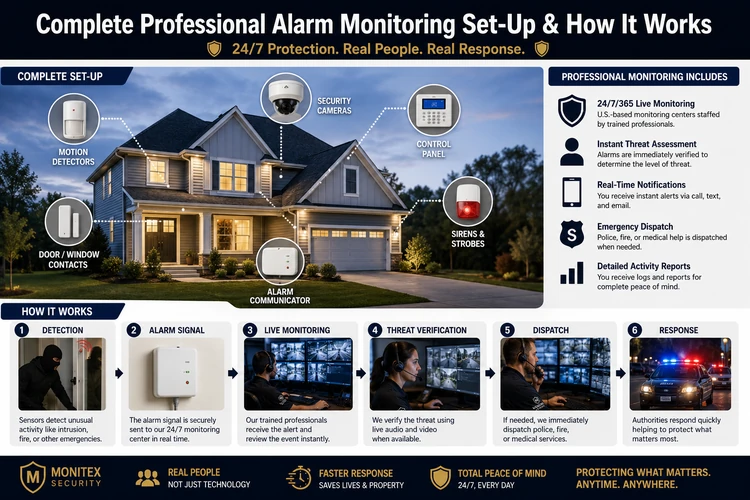
A professional monitoring center collapses that chain. When your sensor trips, the signal travels to a UL-listed central station within seconds. A trained operator reviews the alert, attempts to verify it (by calling you or checking camera footage), and contacts the appropriate emergency service if verification confirms a threat. The whole process often takes under two minutes from trigger to dispatch, which is the kind of speed that actually matters when a window is being forced open at 2 a.m.
Beyond burglary, professional monitoring also covers fire, carbon monoxide, medical emergencies, and flooding, depending on your sensor setup, and learning more about these capabilities is available through the website. That breadth of coverage is one of the main reasons homeowners and businesses in high-risk areas continue to choose monitored systems even as DIY smart home security improves.
How the Technology Behind a Monitoring Center Actually Works
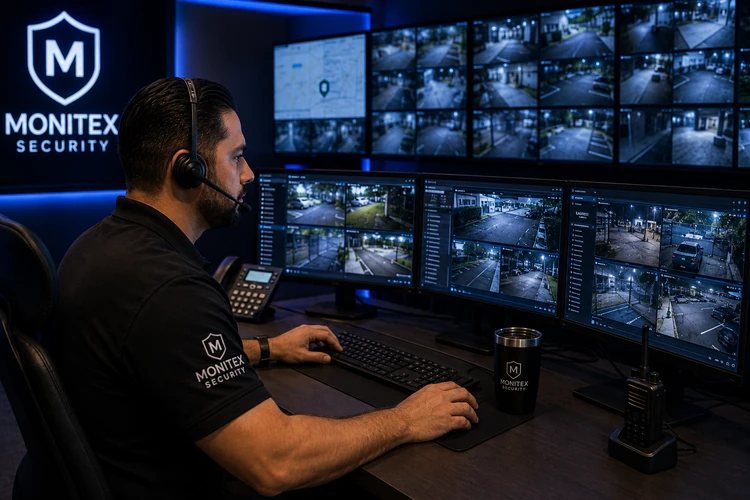
Most people picture a single security guard watching a wall of screens. The reality is far more layered. Modern UL-listed central stations run redundant power systems, backup communication paths (cellular, broadband, and landline), and automated alert-routing software that prioritizes alarms by type and severity. The Underwriters Laboratories certification standards for central stations set detailed requirements around staffing ratios, backup power duration, and geographic redundancy.
When a sensor on your property triggers, here is the typical sequence of events:
- Signal transmission: Your alarm panel sends an encrypted signal over cellular or broadband to the monitoring center.
- Alert receipt: Software logs the alarm type, location, and account details in under one second.
- Operator review: A trained operator pulls up your account, sees the alarm zone, and checks any associated camera feed.
- Verification attempt: The operator calls your contact list in order. If no one answers or the passphrase is wrong, dispatch is initiated.
- Emergency dispatch: The operator contacts local police, fire, or EMS with your exact address and alarm type.
- Follow-up: You receive a notification of what happened and which services were sent, even if you missed the original call.
This is where video verification becomes critical. Traditional sensors create a binary signal: something moved, or it did not. A camera-linked system lets the operator actually see whether someone is breaking in or whether your dog knocked over a lamp. For more context on how live video integrates into modern alert systems, the video monitoring live alerts resource from Monitex Security breaks down how camera feeds feed directly into the operator’s response workflow.
What Professional Monitoring Costs in the United States
Pricing for monitoring services in the U.S. varies significantly based on contract length, technology tier, and whether equipment is bundled. Here is a realistic breakdown of what you should expect to pay:
| Monitoring Tier | Monthly Cost (Approx.) | Key Features |
| Basic (sensor alerts only) | $15 – $25 | 24/7 dispatch, fire and CO monitoring |
| Standard (with cameras) | $25 – $45 | Video clips sent on alarm, app control |
| Premium (video verified) | $40 – $65 | Live video review, priority dispatch |
| Commercial / Business | $50 – $150+ | Multi-zone, guard response options |
Most providers also charge an equipment fee upfront, ranging from $100 to $500+, depending on how many sensors, cameras, and smart devices your system includes. Some companies, including Monitex Security (reachable at 929-279-4999 or [email protected]), offer customized packages that fit residential and commercial properties in New York and nationwide.
One financial benefit that often gets overlooked: many U.S. homeowners insurance carriers offer discounts of 10 to 20 percent when your system is professionally monitored, as detailed in resources like the protection insights blog. The Insurance Information Institute confirms that monitored alarm systems are among the most commonly rewarded security measures in premium calculations. Over a year, that discount can offset a significant portion of your monthly monitoring fee.
Choosing a Provider: What Separates a Strong Monitoring Service from a Weak One
Not all monitoring companies are built the same. Before you commit to a contract, there are several concrete factors worth evaluating.
UL Listing and Redundancy A UL-listed central station has passed independent audits for backup power, staffing, and failover systems. If a provider cannot confirm their station’s UL listing, that is a red flag. The CSAA International standards set the industry benchmark that reputable providers meet.
Contract Terms Longer contracts (36 to 60 months) often come with lower monthly rates but high cancellation penalties. Month-to-month options exist and are growing in popularity, especially among renters. If you are renting an apartment, this flexibility matters more than you might initially think. For renters specifically, understanding your vulnerability is the first step, and resources like apartment theft prevention outline the specific risks that apartment dwellers face and how monitoring fills the gaps that building security often misses.
Response Time Guarantees Ask providers what their average alarm-to-dispatch time is. Industry leaders typically cite under 45 seconds for verified alarms. If a company cannot give you a concrete figure, keep looking.
Technology Integration Modern systems should integrate with smart home platforms (Z-Wave, Zigbee, or proprietary hubs), support mobile app control, and offer two-way audio on indoor cameras. Older monitoring packages that only accept landline signals are becoming obsolete and are worth avoiding.
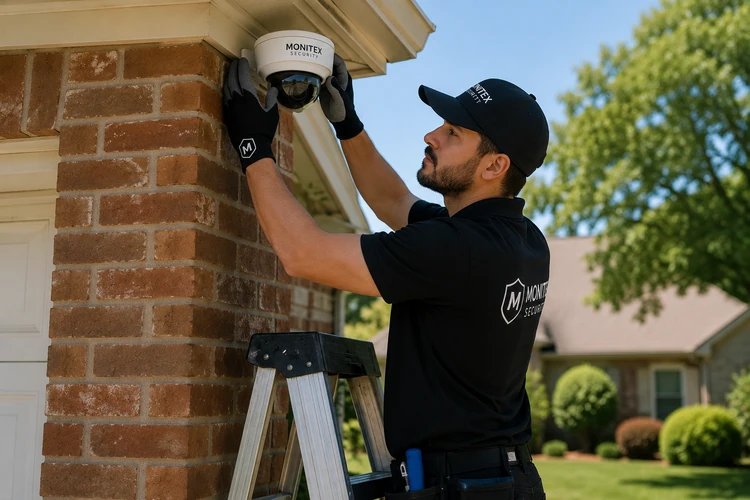
Camera Coverage Planning A monitoring service is only as effective as the sensors and cameras feeding it data. Poor placement creates blind spots that undermine the entire investment. The camera coverage 101 resource from Monitex Security provides placement guidance that directly impacts what your monitoring center can actually see and respond to.
Common Mistakes That Undercut Your Monitored System
Having a professional monitoring subscription does not automatically mean your property is well-protected. There are specific installation and behavioral errors that reduce the value of even the most expensive monitoring plan. The 5 security system mistakes that invite crimes article identifies the patterns that security professionals see repeatedly, including sensor gaps on secondary entry points and outdated panel firmware that prevents signals from reaching the monitoring center.
Some of the most common oversights include:
- Not updating your emergency contact list after moving or changing phone numbers, which delays verification calls.
- Disabling motion sensors during daytime hours and forgetting to re-enable them at night.
- Relying on a single communication path (Wi-Fi only) without a cellular backup, leaving your system silent if your router goes offline.
- Failing to test your system monthly, which is a practice recommended by the National Fire Protection Association for fire alarm components specifically.
- Positioning cameras for aesthetics rather than coverage, creating large blind zones around entry points.
Staying current on best practices is an ongoing process, not a one-time setup task, and the protection insights blog from Monitex Security regularly publishes practical guidance for both residential and commercial property owners navigating these decisions.
Things to Know
- False alarms account for a significant majority of police alarm calls in the U.S., which is why many municipalities have enacted false alarm ordinances with fines starting at $25 to $100 per incident after the first few.
- Video verification is not just a premium feature anymore. It is becoming a baseline expectation at mid-tier monitoring price points.
- Cellular backup is now the industry standard for signal transmission. If a provider still relies primarily on a landline phone connection, ask about their upgrade path.
- Medical alert monitoring is a distinct sub-category of professional monitoring that connects elderly or at-risk individuals to emergency response through wearable panic buttons.
- Not all states regulate alarm monitoring companies equally. In New York, installers and central stations must meet specific licensing requirements under state law.
- Monitex Security, founded in 2019 and operating with a team of over 200 professionals, serves clients across New York and nationwide, providing monitoring solutions scaled to both residential and commercial needs.
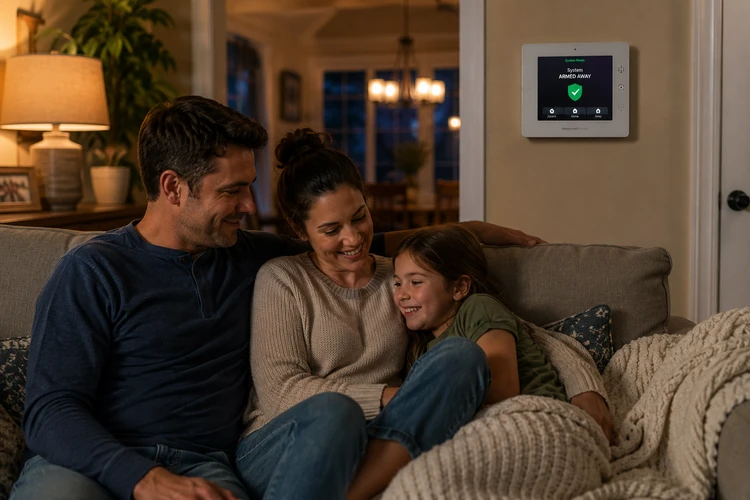
Ready to Activate Monitoring That Actually Responds?
Visit the site to review the monitoring options Monitex Security offers for homes, apartments, and commercial properties across New York and nationwide. Call 929-279-4999 or email [email protected] to speak with a security specialist who can assess your property layout, recommend the right sensor and camera configuration, and connect you to a monitoring plan with no obligation. Take that step today, because the only thing worse than experiencing a break-in is realizing afterward that your system was sending alerts to a phone no one was watching.
Frequently Asked Questions
Q: What is the difference between professional alarm monitoring and self-monitoring?
Professional alarm monitoring means a trained operator at a 24/7 central station handles your alarm response, while self-monitoring puts that responsibility entirely on you.
With professional monitoring, if your alarm triggers while you are driving, sleeping, or in a dead zone, the central station still dispatches help. Self-monitoring requires you to see the alert, assess it, and call 911 yourself, all within a window that may be too short to matter.
Q: How much does professional alarm monitoring cost per month in the U.S.?
Monthly fees in the United States typically range from $15 to $65, depending on the tier of service and whether video verification is included.
Basic plans covering sensor alerts and emergency dispatch start at the lower end. Premium plans with live camera review, smart home integration, and priority dispatch sit closer to $50 to $65 per month. Commercial properties generally pay more based on system complexity.
Q: Can professional monitoring lower my homeowners insurance premium?
Yes, many U.S. insurance carriers offer discounts of 10 to 20 percent for professionally monitored alarm systems.
You will typically need to provide a certificate of monitoring from your provider to qualify for the discount. The savings vary by insurer and state, so ask your insurance agent specifically about alarm monitoring credits when reviewing your policy.
Q: What happens if my internet goes down, will my monitored alarm still work?
If your system has a cellular backup communicator, it will continue transmitting signals to the monitoring center even without an internet connection.
Cellular backup is now a standard feature in most professionally installed systems. If your current setup relies only on Wi-Fi or a landline, upgrading to a dual-path communicator is one of the most important reliability improvements you can make.
Q: Is a long-term contract required for professional alarm monitoring?
No, many providers now offer month-to-month monitoring plans, though longer contracts often come with lower monthly rates.
If you are renting, moving frequently, or simply want flexibility, prioritize providers that offer no-contract options. Be sure to read the cancellation policy carefully regardless of contract length, since some companies charge fees for early termination even on plans marketed as flexible.
The Bottom Line on Professional Alarm Monitoring
Professional alarm monitoring fills the single most important gap in any home or business security setup: the human response layer that activates when you cannot. The technology has improved significantly, with video verification cutting false dispatches and cellular backup eliminating the vulnerabilities that older phone-line systems carried. The cost is realistic for most households, and the insurance discount often softens the monthly expense further.
Your next step is straightforward. Audit what you currently have, check whether your signal path has cellular backup, confirm your contact list is current with your monitoring provider, and review your camera placement against actual entry points on your property. If you do not yet have a monitored system, get a quote from a licensed provider who can walk through your specific layout rather than offering a generic package.