
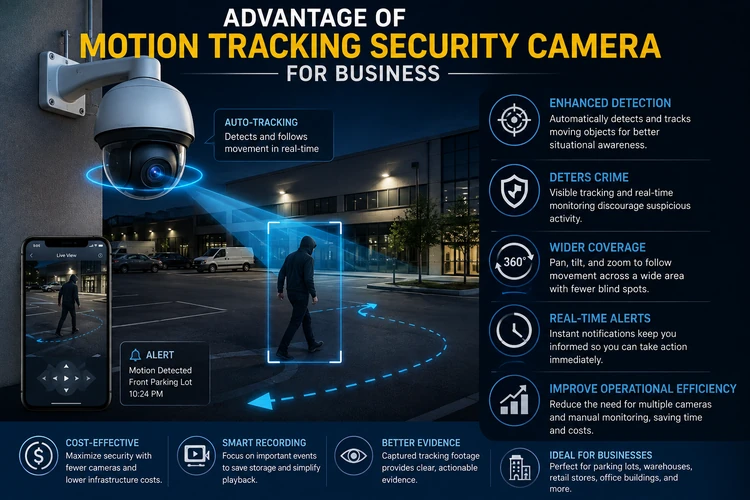
Motion tracking security cameras automatically follow movement across a scene, giving your business live, responsive surveillance without requiring a dedicated operator to manually pan the feed. Understanding the full advantage of motion tracking security camera for business use helps you make smarter decisions about how you allocate your security budget and protect your assets around the clock.
Key Takeaways
- Motion tracking cameras actively follow subjects across wide areas, eliminating blind spots that fixed cameras leave behind.
- They reduce the need for large numbers of static cameras, which can lower your overall installation and hardware costs.
- Integrated analytics and alerts mean your security team responds faster to genuine threats rather than reviewing hours of irrelevant footage.
- These cameras work best when paired with professional monitoring services that can act on alerts in real time.
- Proper camera placement strategy is critical to getting full coverage value from motion tracking technology.
- Businesses in high-traffic or large-footprint environments, such as warehouses, parking lots, and retail floors, benefit most from this type of camera.
Why Fixed Cameras Alone Are No Longer Enough for Most Businesses
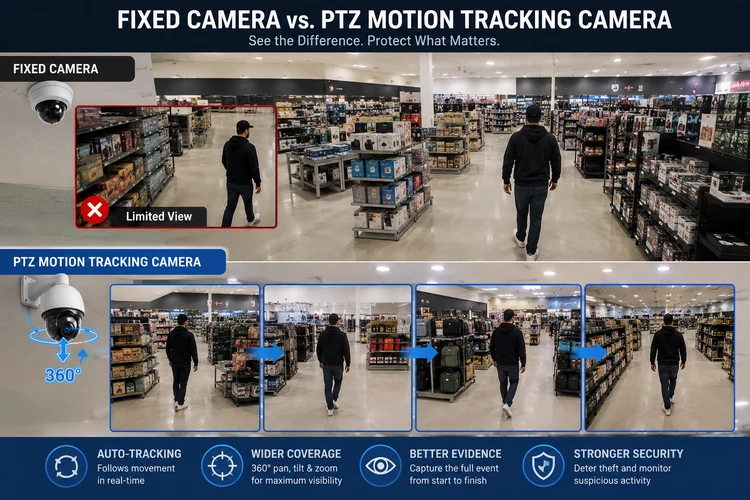
If your business relies entirely on fixed-angle cameras, you are accepting coverage gaps as a permanent feature of your security setup. Fixed cameras capture what is directly in their field of view, period. The moment a subject moves outside that frame, you lose them. For a retail store, a parking garage, or a large warehouse, that limitation is more than an inconvenience; it is a genuine vulnerability.
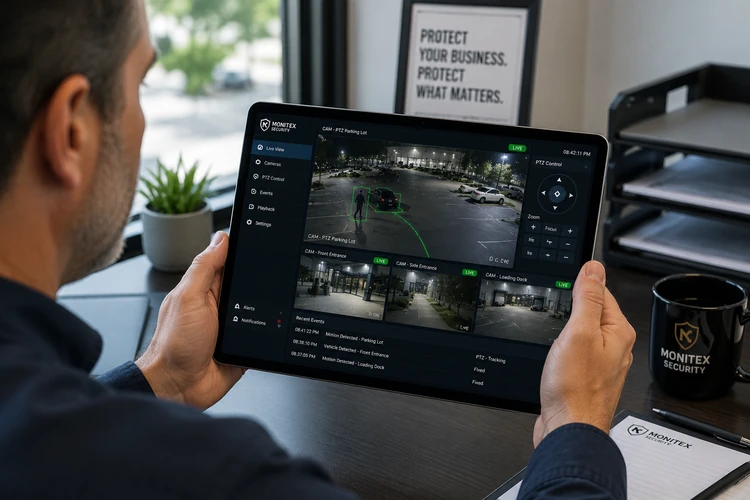
Motion tracking cameras solve this problem by using motorized pan-tilt-zoom (PTZ) mechanisms combined with onboard or cloud-based software that detects movement and repositions the camera lens to follow it. The result is a single camera capable of covering the area that would otherwise require three or four fixed units.
The protection insights blog from Monitex Security covers how businesses across different industries are rethinking their camera strategies to keep up with modern threats, and motion tracking technology consistently comes up as one of the most impactful upgrades available today.
How Motion Tracking Technology Actually Works
Motion tracking in security cameras is not a single feature; it is a layered system of hardware and software working together. Here is how the core components interact:
Detection layer: The camera’s sensor or connected software continuously scans the video frame for changes in pixel patterns that indicate movement. Some systems use basic motion detection, while advanced versions use AI-based object recognition to distinguish between a person, a vehicle, an animal, or a shadow.
Tracking layer: Once a moving object is detected and classified, the camera’s PTZ motor activates. The lens follows the subject across the scene, keeping them centered or at least within the frame as they move.
Alert layer: When motion is detected, the system can simultaneously trigger an alert to your monitoring station, your smartphone, or a third-party security provider. This is where real-time response becomes possible.
Recording layer: Most modern systems record only when motion is detected, which reduces storage costs and makes footage review much faster.
For businesses that want to go beyond on-site recording, cctv remote monitoring services for perimeter security offered by providers like Monitex Security allow trained professionals to watch live feeds and act on alerts before a situation escalates.
The Core Advantage of Motion Tracking Security Camera for Business Operations
The primary advantage of motion tracking security camera for business owners is not just wider coverage; it is smarter coverage. Here is a breakdown of the specific benefits and how they translate to real operational value:
Broader Area Coverage With Fewer Cameras
A single PTZ camera with effective motion tracking can cover up to 180 degrees or more of a space by rotating and zooming. For large facilities like warehouses, loading docks, or open parking areas, this reduces the number of cameras you need to install and maintain.
Faster Incident Response
Because the camera actively follows subjects rather than waiting for a human operator to notice movement on a static feed, alerts are triggered faster. Security personnel or monitoring teams receive notification while the event is still unfolding, not after the fact.
Stronger Deterrence
Visible PTZ cameras that physically move send a clear signal to anyone considering theft, vandalism, or unauthorized entry. A camera that turns to follow you is significantly more intimidating than one mounted at a fixed angle.
Detailed Footage for Investigations
Motion tracking keeps subjects in frame longer, which means better quality footage that is actually useful for identifying individuals or reconstructing events. Fixed cameras often capture only a brief clip of a subject crossing the frame before they exit coverage entirely.
Integration With Broader Security Systems
Modern motion tracking cameras do not operate in isolation. They connect to alarm systems, access control panels, and monitoring platforms. Professional alarm monitoring services can integrate camera alerts with alarm triggers, creating a unified response protocol that closes the gap between detection and action.
Comparing Motion Tracking Cameras to Fixed Cameras: A Quick Breakdown
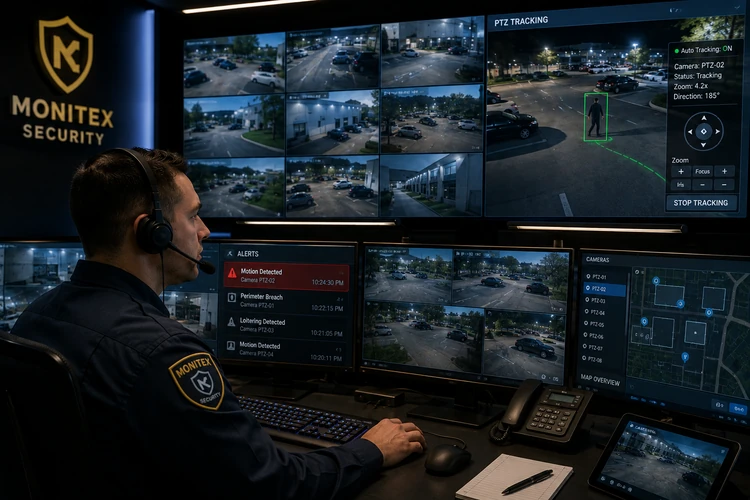
| Feature | Fixed Camera | Motion Tracking Camera |
| Coverage Area | Limited to one angle | Wide, dynamic, follows movement |
| Number of Units Needed | Higher for equal coverage | Fewer units per square foot |
| Footage Quality on Moving Subjects | Often loses subject at frame edge | Keeps subject centered |
| Alert Speed | Passive, relies on review | Active, real-time triggers |
| Deterrence Value | Moderate | High (visible tracking) |
| Storage Efficiency | Records continuously | Records on motion only |
| Installation Cost Per Unit | Lower | Higher, but offset by fewer units |
| Best Use Case | Doorways, narrow corridors | Large open areas, parking, retail floors |
Where Motion Tracking Cameras Deliver the Most Value
Not every business environment benefits equally. Here are the settings where the return on this technology is strongest:
Retail stores: Tracking shoppers across aisles, near high-value merchandise sections, and at exits helps loss prevention teams catch incidents in real time rather than reviewing footage hours later.
Warehouses and distribution centers: Large floor spaces with multiple entry points are notoriously difficult to fully cover with fixed cameras. Motion tracking cameras handle wide open areas efficiently.
Parking garages and lots: Low lighting, large areas, and limited foot traffic make parking facilities a common target. A camera that follows a vehicle or person across the lot is far more effective than a grid of fixed units that may miss movement between angles.
Office buildings: Monitoring after-hours movement in lobbies, stairwells, and server rooms benefits directly from active tracking rather than passive recording.
Construction sites: Equipment theft is a serious issue at US construction sites, and temporary PTZ setups with motion tracking are a cost-effective way to monitor large, open perimeters.
For understanding how to position cameras in any of these environments for maximum effectiveness, camera coverage 101 is a practical resource that walks through placement principles in plain language.
Things to Know
- Motion tracking cameras require proper calibration to avoid false positives, such as triggering on shadows, reflections, or HVAC vents moving nearby objects.
- AI-powered object classification significantly reduces false alerts compared to basic pixel-change detection, but it typically comes at a higher price point.
- PTZ motors have mechanical parts that wear over time. Factor maintenance contracts into your total cost of ownership.
- Not all motion tracking systems work equally well in low light. Verify infrared or low-light performance specs before purchasing for exterior or dimly lit indoor use.
- Cloud storage for motion-triggered recordings involves ongoing subscription costs. Confirm your data retention period matches what local law enforcement may require for evidence purposes.
- Residential-grade PTZ cameras marketed cheaply often lack the frame rate, zoom quality, or tracking accuracy needed for commercial settings. Invest in commercial-grade hardware.
Legal Considerations for Business Surveillance in the United States
Before deploying any camera system, businesses must understand the applicable laws. In the United States, recording in areas where employees or customers have a reasonable expectation of privacy, such as restrooms or changing rooms, is prohibited under federal and various state laws. The Electronic Communications Privacy Act provides the federal framework, while states like California and Illinois have additional requirements.
Signage is also a factor. Many states require businesses to post visible notices informing individuals they are under video surveillance. Consult with a legal professional familiar with your state’s specific statutes before finalizing camera placement.
The American Civil Liberties Union’s guidance on surveillance is a useful reference for understanding civil liberties considerations around business and public space recording.
Monitex Security, operating in New York and nationwide, advises clients on compliant camera deployment as part of the consultation process. You can reach their team directly at [email protected] or by calling 929-279-4999.
Combining Motion Tracking With a Full Security Ecosystem
Motion tracking cameras are powerful on their own, but they reach their full potential when integrated with the rest of your security infrastructure. Consider the following combinations:
Camera plus professional monitoring: A live monitoring team can view real-time tracking footage and contact law enforcement with precise descriptions and location data while an incident is still occurring.
Camera plus access control: When a door alarm triggers, a motion tracking camera in that zone can automatically focus on the entry point, giving your monitoring team an immediate visual on what is happening.
Camera plus alarm system: Synchronized alerts between cameras and intrusion alarms reduce response time and eliminate the ambiguity of solo alarm notifications.
For businesses that also have facilities at home or executive residences tied to the same security network, home alarm monitoring services from Monitex can extend consistent protection across both environments.
The National Institute of Justice’s research on crime prevention through environmental design supports the principle that visible, responsive surveillance systems act as a meaningful deterrent to opportunistic crime, which aligns directly with what well-deployed motion tracking systems provide.
Protect Your Business With Motion Tracking Today
Your security system should work as hard as you do, not sit idle and miss events your business depends on catching. Monitex Security has helped businesses across New York and nationwide build smarter surveillance setups that combine motion tracking cameras with professional monitoring and alarm integration.
Contact Monitex Security today at to discuss a camera strategy built specifically for your facility size, layout, and risk profile. The team at Monitex is ready to design a solution that actually fits your operation rather than a generic package. Contact For Inquiry by calling 929-279-4999 or emailing [email protected] and speak with a security expert who understands what your business needs.
Frequently Asked Questions
Q: How many motion tracking cameras does a typical business need?
The number depends on your facility’s square footage, layout, and the number of entry and exit points you need to cover.
A small retail store may require only two to three PTZ cameras positioned at key angles, while a large warehouse or parking facility could need eight or more. A professional site assessment from a provider like Monitex Security gives you an accurate count based on your specific environment rather than a generic estimate.
Q: Are motion tracking cameras more expensive than fixed cameras?
Yes, motion tracking PTZ cameras carry a higher upfront cost per unit than standard fixed cameras, but the total system cost is often comparable because fewer units are needed.
The savings in hardware, cabling, and installation labor for a multi-fixed-camera setup can offset the premium for PTZ units. Factor in ongoing maintenance costs for the PTZ motor when calculating long-term value.
Q: Can motion tracking cameras work in complete darkness?
Many commercial-grade motion tracking cameras include infrared or thermal imaging capabilities that allow them to track movement in low or zero-light conditions.
However, the quality and range of night vision varies significantly between models. Always verify the camera’s low-light specifications before purchasing for exterior or nighttime use scenarios.
Q: What happens if the motion tracking camera loses a subject between frames?
Most modern systems include a short-duration hold function where the camera remains on the last known position for several seconds before returning to its home position or patrol pattern.
Higher-end AI systems can also predict movement trajectory and reposition ahead of where the subject is likely to appear next. Choosing a camera with predictive tracking reduces the chance of losing a subject mid-event.
Q: Do I need internet access for motion tracking cameras to work?
Basic motion tracking and local recording functions typically work without an active internet connection, but remote viewing, cloud storage, and alert notifications require connectivity.
For professional monitoring integrations, a stable internet connection is essential. Monitex Security can assess your connectivity setup and recommend solutions that ensure reliable alert delivery even during partial outages.
The Bottom Line on Advantage of Motion Tracking Security Camera for Business
The advantage of motion tracking security camera for business is straightforward: you get wider coverage, faster alerts, better footage, and stronger deterrence from a system that actively responds to threats rather than passively recording them. For most businesses managing real-world security challenges, that shift from passive to active surveillance is the most significant upgrade available without a complete infrastructure overhaul.
Start by identifying the highest-risk zones in your facility, then consult with a qualified provider to determine whether PTZ motion tracking, fixed cameras, or a hybrid approach gives you the best coverage for your layout and budget. Monitex Security is available to help you take that first step with confidence with our professional alarm monitoring services and comprehensive security solutions.