
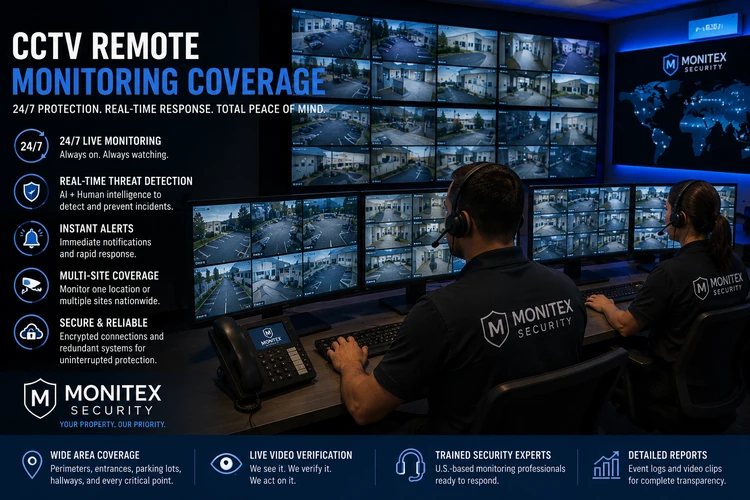
CCTV remote monitoring for perimeter security coverage give trained operators real-time visibility over your property boundaries, 24 hours a day, without requiring on-site guards at every post. When a threat is detected, a live operator can assess the situation, trigger audio deterrents, and dispatch law enforcement within minutes, often before any damage or theft occurs.
Key Takeaways
- Remote monitoring combines high-definition cameras with live human operators, making it more effective than passive recording alone.
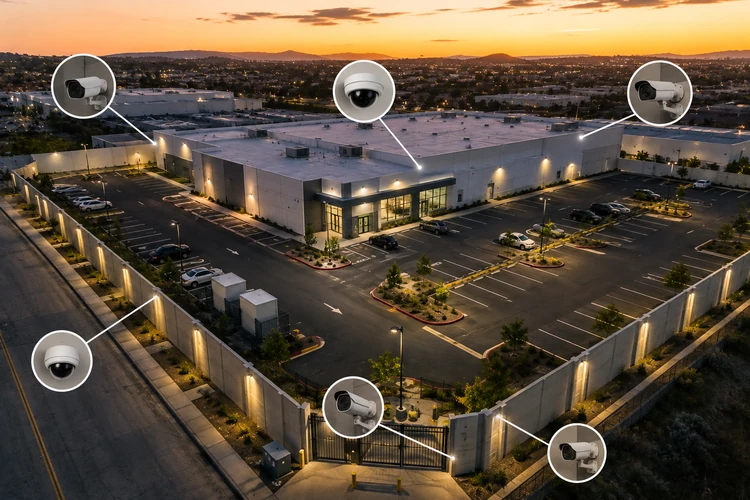
- Perimeter-focused coverage requires strategic camera placement at entry points, fence lines, and blind spots.
- Verified video alarms dramatically reduce false alarm dispatches and improve police response priority.
- Industries like construction, banking, and retail see the highest ROI from perimeter surveillance systems.
- Choosing a monitoring provider with UL-listed central stations and licensed operators matters as much as the hardware itself.
- Costs vary widely depending on site size, camera count, and monitoring plan, but remote solutions consistently undercut the expense of full-time security guards.
Why Perimeter Security Is the First Line of Defense
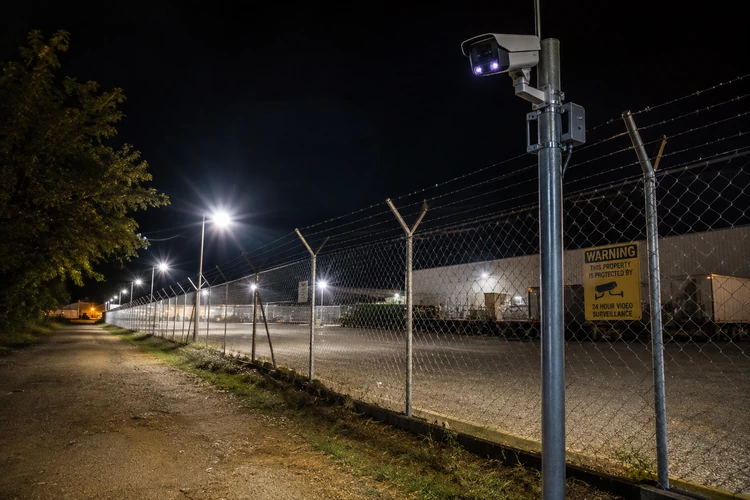
Most security breaches do not start inside a building. They start at the fence line, the parking lot edge, or an unmanned gate at 2 a.m. Perimeter security is the concept of stopping a threat before it ever reaches your asset, and cameras positioned around property boundaries are the foundation of that strategy.
Traditional security relied on static guards posted at entry points. A single guard covering a large commercial property or industrial yard simply cannot maintain 360-degree situational awareness all night. Fatigue, distraction, and limited sightlines create gaps that criminals actively exploit. Cameras do not get tired. When those cameras are connected to a remote monitoring center staffed by trained professionals, you get consistent coverage that scales with the size of your site.
The shift toward technology-backed perimeter defense is also being driven by insurance. Many commercial property insurers in the United States now offer reduced premiums for facilities with verified video monitoring systems in place. The reason is simple: verified alarm events reduce false dispatches, and faster response times reduce claim values.
How CCTV Remote Monitoring Actually Works
Understanding the technical pipeline helps you evaluate providers more accurately and avoid paying for features that do not serve your specific site.
The Core Technology Stack
A functional remote monitoring setup involves four layers working together:
- Cameras: High-definition IP cameras with infrared night vision, motion analytics, and wide dynamic range for high-contrast lighting conditions.
- Edge processing: On-site NVRs or AI-enabled cameras that filter motion events before sending alerts, reducing the volume of false triggers.
- Secure transmission: Encrypted data feeds sent to a central monitoring station over fiber, LTE, or satellite depending on site connectivity.
- Human operators: Licensed security professionals who review live feeds, verify threats, and take escalation actions in real time.
The human verification step is what separates remote monitoring from simple cloud recording. When an analytics-triggered alert fires, an operator pulls up the live feed, assesses whether the event is a genuine threat, and responds accordingly. This might mean broadcasting a live audio warning over on-site speakers, calling local law enforcement, or notifying the property owner directly.
Video Analytics and AI Integration
Modern CCTV remote monitoring services for perimeter security use AI-assisted analytics to pre-screen events. The system can be configured to differentiate between a person crossing a defined virtual tripwire versus an animal moving through the frame. It can flag vehicles stopping in restricted zones, detect loitering behavior exceeding a set time threshold, or identify individuals approaching after-hours. These analytics reduce operator workload and improve response speed because alerts are already pre-qualified by the time a human reviews them.
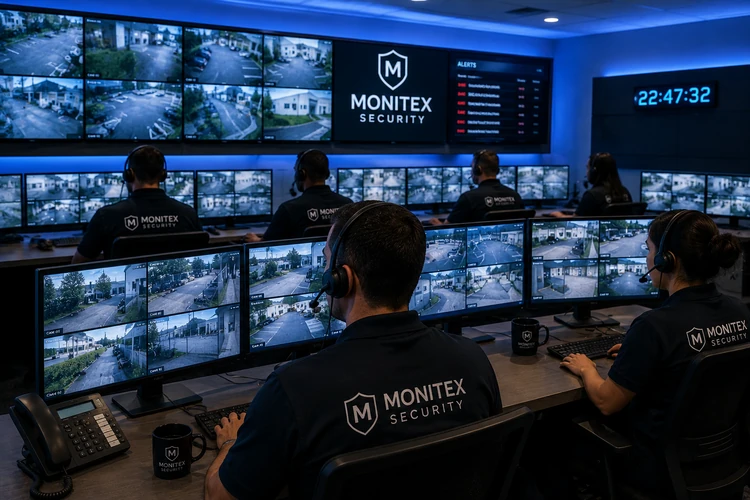
Providers like Monitex Security, which has been operating since March 2019 and serves clients across New York and nationwide, integrate analytics-driven camera networks with 24/7 staffed monitoring centers that you can learn more about through the protection insights blog. Their team of 200 trained professionals handles the full escalation chain, from initial alert through law enforcement coordination.
Industries That Benefit Most From Perimeter Monitoring
Remote perimeter surveillance is not one-size-fits-all. Certain industries have risk profiles that make this technology particularly high-value.
Construction Sites
Construction yards are among the highest-theft environments in the country. The National Equipment Register estimates that equipment theft costs the U.S. construction industry between $300 million and $1 billion annually. Materials like copper wiring, lumber, and heavy machinery are valuable targets that are almost always stored outdoors, making perimeter monitoring the most logical solution.
Construction sites present unique monitoring challenges including changing layouts, temporary power, and no permanent structures for camera mounting. Monitex Security addresses these challenges with mobile surveillance towers and flexible camera configurations. You can read more about their dedicated approach through monitex security for construction sites surveillance to understand how specialized setups differ from standard commercial installs.
Banking and Financial Institutions
Branches and ATM clusters require both interior and exterior surveillance that meets regulatory requirements. Perimeter cameras covering drive-throughs, parking lots, and building approaches are standard components of a compliant setup. The ultimate guide to bank security monitoring and safety outlines how financial institutions layer remote video with access control and alarm systems to meet both security and compliance goals.
Residential and Commercial Properties
Homeowners with large lots, gated driveways, or high-value assets stored outdoors benefit significantly from perimeter coverage. Home alarm monitoring complements perimeter cameras by integrating door and window sensors with exterior video, giving you a unified picture of any threat developing around or inside your property.
Comparing Remote Monitoring Options: What the Market Looks Like
Not all remote monitoring providers offer the same depth of service. The table below breaks down the key differentiators you should evaluate before signing a contract.
| Feature | Basic Cloud Recording | Automated Alert System | Full Remote Monitoring |
| Live human operators | No | No | Yes |
| Real-time threat response | No | Limited | Yes |
| Audio deterrent capability | No | Rare | Yes |
| Law enforcement coordination | No | No | Yes |
| AI video analytics | Sometimes | Yes | Yes |
| False alarm filtering | No | Partial | Yes |
| Monthly cost range | $20-$80 | $100-$300 | $300-$1,500+ |
The cost difference between basic cloud recording and full remote monitoring is significant, but so is the capability gap. A basic system records everything and alerts you after the fact. A full remote monitoring service stops the event as it happens or prevents it altogether.
Things to Know
- Most U.S. cities require a permit for alarm systems, and some jurisdictions charge fines for excessive false alarm dispatches, making verified video monitoring especially important.
- Camera resolution matters most at perimeter distances of 30 feet or more. 4K cameras with varifocal lenses outperform standard 1080p in identifying individuals at the boundary line.
- Outdoor cameras require IP66 or IP67 weatherproof ratings to perform reliably through New York winters or high-humidity Southern summers.
- Wireless cameras are easier to deploy on sites without existing conduit, but they require stable cellular or Wi-Fi signal, and interference can cause gaps in coverage.
- Monitoring contracts typically run 12 to 36 months. Read the escalation protocols and guaranteed response times before signing.
- Not all monitoring centers are UL-listed. UL-listed central stations meet strict operational standards for backup power, redundancy, and operator training.
Regenerate section
Setting Up Your Perimeter Coverage: Practical Considerations
Before calling a provider, doing your own site assessment saves time and gets you a more accurate quote. Walk your property boundary and identify the following:
- Entry and exit points: Every gate, door, or gap in fencing needs dedicated coverage.
- Blind spots: Areas blocked by trees, equipment, or building angles create vulnerabilities that a camera plan must address.
- Lighting conditions: Poor lighting is the most common reason cameras underperform. IR cameras help, but supplemental perimeter lighting significantly improves image quality and acts as a passive deterrent.
- Power and connectivity: Determine whether you have existing infrastructure or need solar-powered or cellular-connected units.
- Critical assets: Prioritize placement based on what you are actually protecting, whether that is equipment, vehicles, inventory, or access to occupied structures.
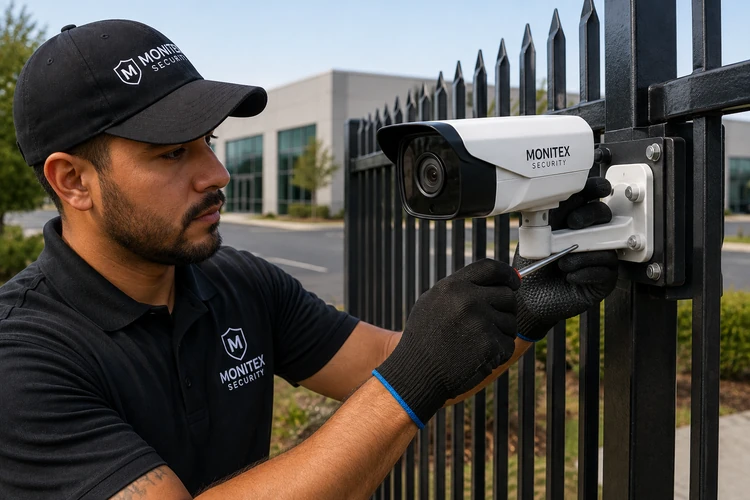
Once you have this information, a professional site assessment from a provider like Monitex Security can map camera fields of view, calculate required storage, and recommend monitoring tiers that match your threat level. You can reach the Monitex team at 929-279-4999 or by emailing [email protected] to schedule a consultation.
For more detailed security guides and industry-specific advice, the protection insights blog covers topics from construction site surveillance to commercial alarm monitoring, making it a useful resource for property managers and business owners alike.
Evaluate Your Provider Before You Commit
Choosing the right monitoring company is as important as the hardware. Ask every prospective provider the following questions:
- Is your central station UL-listed?
- What is your average verified alarm response time?
- Do your operators have access to live two-way audio on-site?
- What escalation steps are taken before law enforcement is contacted?
- What happens during an internet or power outage at my site?
- Are your contracts month-to-month, or do you require a multi-year commitment?
Providers that hesitate on any of these questions or cannot produce documentation should raise concerns. The Monitex Security team, operating since 2019 and serving clients from New York to international locations, maintains transparent service agreements and staffs its center with licensed professionals trained in threat verification and emergency coordination.
You can also visit to review their full range of services, including perimeter surveillance packages tailored for commercial, residential, and industrial clients.
Start Protecting Your Perimeter Today with Monitex Security
Your property boundary is the most important line you can defend, and every day without verified perimeter monitoring is a day that boundary goes unguarded after hours. Monitex Security provides professionally managed cctv remote monitoring services for perimeter security that combine AI-assisted cameras with 24/7 live operators who respond immediately when a threat is detected. Contact For Inquiry today by calling 929-279-4999 or emailing [email protected], and a Monitex specialist will assess your site and build a coverage plan that fits your risk profile and budget.
Frequently Asked Questions
Q: How quickly does a remote monitoring operator respond to a perimeter alert?
With a properly configured system, verified response typically takes between 30 and 90 seconds from the initial trigger.
Operators receive pre-qualified alerts from the analytics layer, which means they are reviewing a confirmed motion or intrusion event rather than a raw video stream. Response time is also affected by the monitoring center’s staffing levels and the quality of your camera feeds, which is why choosing a UL-listed provider with documented response benchmarks matters.
Q: Can remote CCTV monitoring replace on-site security guards entirely?
In many scenarios, yes, remote monitoring can replace or significantly reduce the need for on-site guards, especially for after-hours coverage.
For sites that require physical access control, visitor management, or hands-on response, a hybrid model combining remote monitoring with a smaller guard presence often makes more sense. The cost savings over full guard coverage are substantial, typically 60 to 80 percent lower for equivalent hours of coverage.
Q: What camera types are best for outdoor perimeter monitoring?
PTZ cameras, fixed wide-angle cameras, and thermal imaging units each serve different perimeter functions depending on site size and threat type.
PTZ cameras allow operators to zoom and track a detected subject. Fixed wide-angle cameras provide continuous overlapping coverage of a defined zone. Thermal cameras detect heat signatures in total darkness, making them ideal for large-acreage sites or high-security facilities. Most professional installations combine at least two of these types.
Q: Are CCTV remote monitoring services worth the monthly cost for small businesses?
For most small businesses with outdoor inventory, parking lots, or after-hours vulnerability, the ROI from preventing even a single theft incident covers months of monitoring fees.
The average commercial burglary in the United States results in a loss of approximately $3,000 according to FBI crime statistics. A mid-tier remote monitoring plan runs between $300 and $600 per month. One prevented incident pays for the service for several months. Add insurance premium reductions and the financial case becomes even more clear.
Q: Does remote CCTV monitoring work in areas with unreliable internet?
Yes, cellular-based and hybrid connectivity options allow remote monitoring to function effectively even where fixed broadband is unavailable or unreliable.
Many providers offer LTE-connected cameras and NVRs with local buffering, which store footage on-site and sync to the monitoring center when connectivity is restored. For critical installations, dual-path connectivity using both broadband and cellular simultaneously provides redundancy that eliminates single-point-of-failure risks.
The Bottom Line on CCTV Remote Monitoring Services for Perimeter Security
Perimeter security is not a feature you add after something goes wrong. It is the layer that prevents the incident from happening in the first place. CCTV remote monitoring services for perimeter security have matured significantly over the past decade, with AI-assisted analytics and professional monitoring centers making the technology accessible and cost-effective for properties of every size.
Whether you manage a construction yard, a retail complex, a financial institution, or a residential estate, verified remote monitoring gives you continuous coverage, faster law enforcement response, and documented evidence that passive recording systems cannot match. Call Monitex Security at 929-279-4999 or email [email protected] to get a site-specific consultation and take the first step toward securing your perimeter before it becomes a vulnerability.