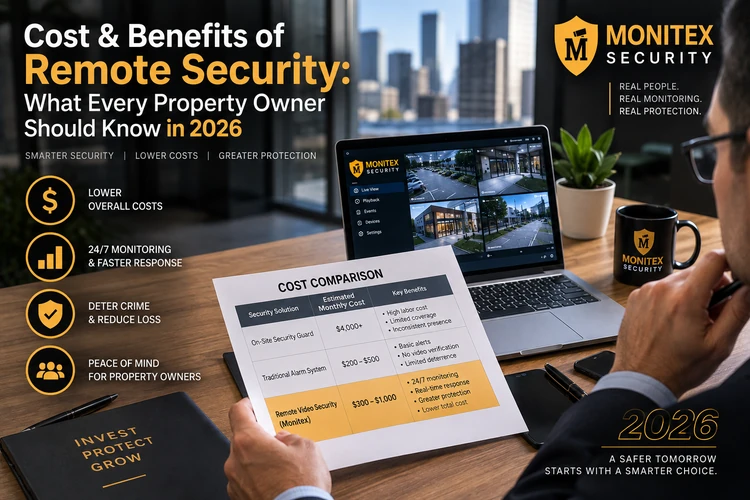
The cost & benefits of remote security come down to a straightforward equation: you pay a predictable monthly or annual fee, and in return you get real-time surveillance, faster incident response, and reduced reliance on on-site staff. For property owners across the United States, this trade-off has become one of the most practical security decisions available in 2026.
Key Takeaways
- Remote security typically costs less than hiring full-time on-site guards, making it accessible for small businesses, large facilities, and residential properties alike.
- Real-time monitoring allows security professionals to detect and respond to threats before they escalate into costly incidents.
- Modern remote systems integrate with cameras, access control, and alarm platforms to create a unified security layer.
- Not every property has identical needs, so understanding the variables in pricing helps you avoid overpaying or underprotecting.
- Combining remote monitoring with periodic physical patrols often produces the strongest overall security posture.
- Scalability is one of the biggest advantages: you can expand coverage as your property or business grows without a complete system overhaul.
What Remote Security Actually Means for Your Property
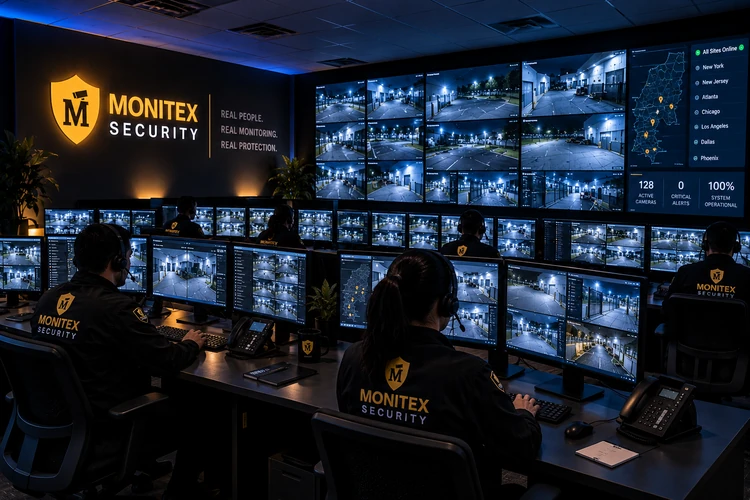
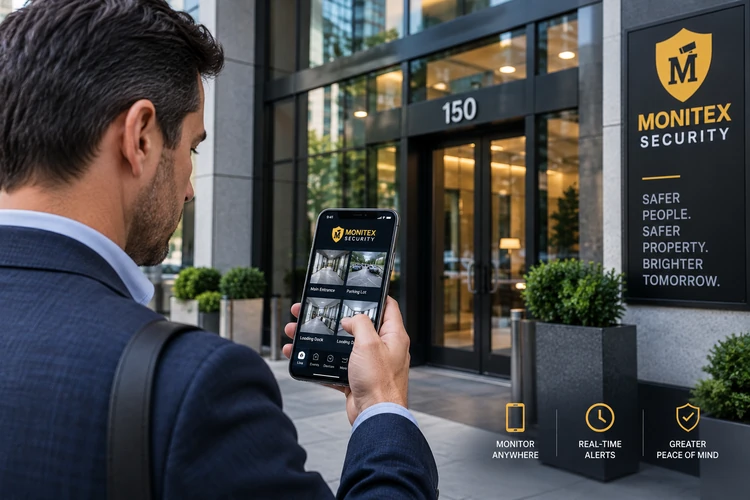
Remote security is not simply a camera pointed at a door. It is a full ecosystem that includes live video monitoring, alarm verification, two-way audio communication, cloud storage, and professional response coordination, all managed from an off-site operations center. When something unusual happens on your property, trained analysts are watching in real time and can contact local law enforcement, on-site personnel, or you directly.
For businesses in New York and across the country, the appeal is clear. Physical guard coverage requires wages, benefits, workers’ compensation insurance, and scheduling overhead. Remote monitoring compresses many of those costs into a single, predictable service fee. That does not mean on-site guards become obsolete; it means they are deployed more strategically where human presence is genuinely irreplaceable.
Monitex Security, founded in March 2019 and now operating with a team of over 200 professionals, has built its service model around exactly this balance. Serving clients in New York and nationwide, the company understands that the right mix of technology and trained personnel creates security that neither component could achieve alone.
To get a deeper look at how camera-based remote systems work in practice, the benefits of remote monitoring for your security camera system page breaks down the specifics of integration and performance.
Breaking Down the Costs of Remote Security
Understanding what you will actually spend is where most property owners need clarity. Costs vary based on the size of your property, the number of cameras and access points, the level of monitoring required, and the response protocols built into your plan.
Monthly Service Fees
Most remote security providers structure their pricing around a monthly monitoring fee. This can range from as low as $30 per month for a basic residential package to several hundred or even thousands of dollars per month for a large commercial facility with multiple camera feeds and 24/7 live analyst coverage. The key distinction here is between passive recording (where footage is stored and reviewed only after an incident) and active live monitoring (where analysts watch feeds in real time).
Active monitoring costs more, but it is also significantly more effective. Passive recording tells you what happened; active monitoring gives you the chance to prevent it.
Equipment and Installation
Hardware costs are a separate line item. Cameras, sensors, access control hardware, and network infrastructure all carry upfront costs. Depending on the complexity of your setup, installation for a mid-sized commercial property can run from a few thousand dollars to tens of thousands. Some providers offer lease-to-own arrangements or bundle equipment costs into higher monthly fees, which can reduce the initial capital outlay.
Comparing to On-Site Guard Costs
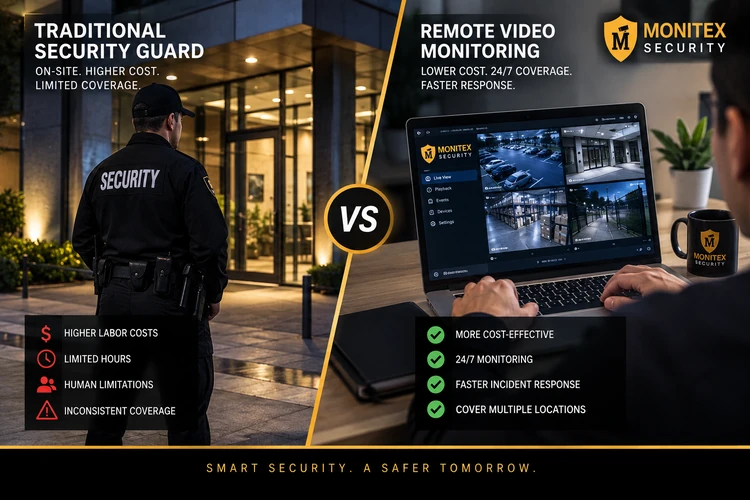
A full-time security guard in New York earns a median hourly wage that, when factored across a 40-hour week plus overtime, benefits, and employer taxes, can easily cost a business $60,000 to $80,000 or more per year per guard. If you need round-the-clock coverage, you are looking at multiple guards across shifts. Remote monitoring, even at the premium end, rarely approaches that cost for equivalent coverage hours.
That said, overnight security staffing needs are one area where the hybrid model shines. Remote monitoring handles continuous surveillance while a physical guard covers high-risk hours or access-controlled entry points, producing better outcomes at lower total spend.
The Core Benefits Worth Evaluating
24/7 Coverage Without Staffing Gaps
One of the most practical advantages of remote security is the elimination of coverage gaps. Human guards take breaks, call in sick, and have shift transitions where attention can slip. A remote monitoring center staffed by rotating teams of analysts operates continuously, without the variability that comes with individual employee performance.
Faster Incident Response
When a remote analyst spots suspicious activity, they can immediately initiate a response protocol: triggering on-site audio warnings, alerting local law enforcement with live video verification, or contacting your designated point of contact. Video-verified alarms are taken more seriously by law enforcement than standard unverified alarm triggers, which means faster dispatch and a higher likelihood of catching an incident in progress.
Deterrence Before Damage
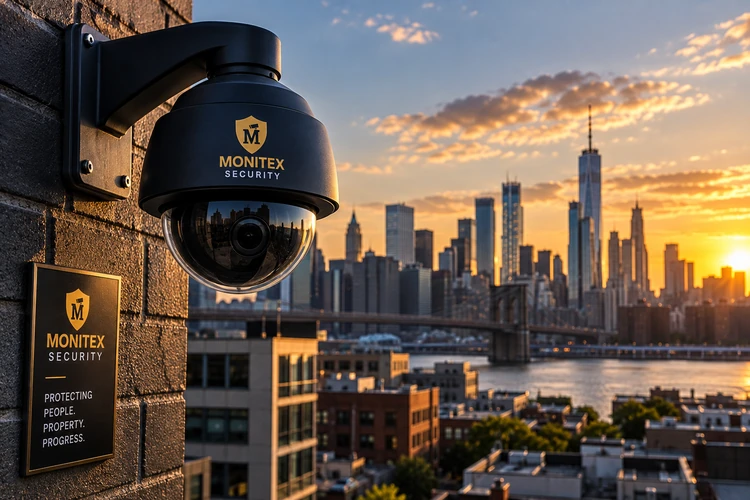
Visible cameras and posted notices of active monitoring act as deterrents before any incident begins. Many would-be criminals avoid properties where they believe someone is actively watching. This preventive value is difficult to quantify precisely, but it is one of the most frequently cited benefits by security professionals and property managers alike.
Scalability and Flexibility
As your business grows or your property footprint changes, a remote security system scales with you. Adding camera feeds, expanding monitored zones, or integrating new access control systems typically requires a software update and hardware addition rather than a full system replacement. This flexibility is a major operational advantage compared to building out physical guard programs, which scale in large increments tied to headcount.
If you want to understand exactly how streaming camera technology fits into this, the page on does remote streaming camera effective for security addresses the technical performance questions directly.
Documented Evidence for Insurance and Legal Purposes
Remote systems with cloud storage maintain tamper-resistant video records that can be retrieved for insurance claims, litigation, or law enforcement investigations. Some insurers in the United States offer premium discounts for properties with professionally monitored security systems, which can partially offset your monthly service costs over time.
Where Remote Security Has Limitations
No security solution is without trade-offs, and an honest evaluation of the cost & benefits of remote security requires acknowledging the gaps.
Response Time for Physical Threats
Remote monitoring speeds up the notification process, but there is still a lag between when an analyst identifies a threat and when physical intervention arrives. In high-crime areas or situations requiring immediate physical presence, that gap can matter. This is why integrating remote monitoring with on-site or rapid-response patrol services remains best practice for high-risk properties.
Dependence on Network Infrastructure
Remote systems rely on internet connectivity. A power outage or network disruption can create blind spots unless backup systems such as cellular failover and battery-powered devices are built into your setup. Any reputable provider will discuss redundancy options with you during the planning phase, so this is a solvable problem rather than a dealbreaker.
Privacy and Compliance Considerations
In states like New York, there are specific rules governing where cameras can be placed and how footage can be stored or shared. Working with a knowledgeable provider helps you stay compliant and protects you from liability. The protection insights blog covers regulatory updates and best practices on an ongoing basis, which is worth bookmarking if you manage a property where compliance is a concern.
How to Evaluate Whether Remote Security Is Right for You
The decision comes down to a few core questions:
- What are you protecting? High-value inventory, sensitive data, or vulnerable populations each carry different risk profiles and monitoring requirements.
- What are your current security gaps? If you have recurring after-hours incidents, remote monitoring is particularly well-suited to address them.
- What is your budget structure? If capital expenditure is tight, providers offering equipment financing or lower upfront hardware costs may be preferable even if the monthly fee is slightly higher.
- Do you need physical presence on-site? If your operation requires someone to check IDs, manage access, or physically respond to altercations, remote monitoring supplements but does not fully replace that role.
Monitex Security works with clients to build customized proposals based on these questions. You can reach the team directly at 929-279-4999 or email [email protected] to start a conversation about your specific situation.
For those interested in joining the team that delivers these services, the careers page lists current openings across technical and operational roles.
A Practical Cost-Benefit Comparison Table
| Factor | Remote Security | On-Site Guard Only | Hybrid Approach |
| Monthly Cost (mid-size commercial) | $200-$800 | $8,000-$15,000+ | $3,000-$8,000 |
| Coverage Hours | 24/7 continuous | Shift-dependent | 24/7 with physical presence |
| Incident Documentation | Automatic (cloud) | Manual (reports) | Both |
| Scalability | High | Low (headcount-based) | Medium |
| Response to Physical Threat | Dependent on dispatch | Immediate (on-site) | Strong |
| Compliance Support | Provider-managed | Self-managed | Shared |
| Deterrence Factor | High (visible tech) | High (physical presence) | Highest |
This table is meant to give you a directional comparison. Your actual costs will depend on your location, property type, existing infrastructure, and the specific service tier you choose.
The Bottom Line on Cost & Benefits of Remote Security
Understanding the full cost & benefits of remote security puts you in a much stronger position to make a decision that actually fits your property and budget. The numbers favor remote monitoring for most commercial and mixed-use properties when you compare total spend against the coverage and documentation quality you receive.
Whether you manage a single retail location in New York or a portfolio of properties across multiple states, the right starting point is an honest assessment of your current vulnerabilities and your budget ceiling. From there, a provider like Monitex Security, reachable at 929-279-4999 or [email protected], can help you build a system that delivers real protection without unnecessary overhead.
Visit the main site to learn more about available service tiers and to request a consultation tailored to your property’s needs.## Things to Know
- Remote security systems are not one-size-fits-all. A retail storefront in Manhattan has fundamentally different coverage needs than a warehouse in a suburban industrial park, and pricing should reflect that difference.
- Many property owners underestimate the cost of not having adequate security. Theft losses, vandalism repairs, liability claims, and higher insurance premiums can far exceed the annual cost of a professional monitoring plan.
- Cloud-based video storage is a critical feature to confirm with any provider. Local-only storage on a DVR can be destroyed, stolen, or corrupted during the very incident you need the footage to document.
- Two-way audio capability, available on many modern remote systems, allows monitoring analysts to verbally warn trespassers in real time, which often de-escalates a situation before law enforcement even needs to be dispatched.
- Response time agreements vary widely between providers. Before signing any contract, ask specifically what the guaranteed response protocol is when an analyst detects an active threat on your property.
- Tax treatment of security system costs can work in your favor. For U.S. businesses, professionally installed security equipment and monitoring fees may qualify as deductible business expenses. Consult a tax professional to confirm what applies to your situation.
Start Protecting Your Property With the Right Remote Security Plan
Making the right security decision requires more than reading about it. You need a real conversation with professionals who understand your property type, your risk exposure, and your budget.
Monitex Security has been protecting clients across New York and nationwide since 2019, and the team is ready to help you build a monitoring plan that delivers genuine coverage without unnecessary cost. Reach out today at 929-279-4999 or email [email protected] to get started.
Contact For Inquiry and speak directly with a Monitex Security specialist who will assess your needs and propose a tailored remote security solution built around your property.
Frequently Asked Questions
Q: How much does remote security monitoring typically cost for a small business in the United States?
For a small business, remote security monitoring generally ranges from $100 to $500 per month depending on the number of cameras, monitoring intensity, and response protocols included in the plan.
Basic packages that cover a handful of cameras with alarm verification tend to sit at the lower end of that range. Full live-monitoring packages with analyst-reviewed feeds, two-way audio, and documented response protocols will cost more. The best way to get an accurate figure is to request a property-specific assessment from a provider like Monitex Security, which can be initiated by calling 929-279-4999.
Q: Is remote security monitoring as effective as having a physical guard on-site?
Remote security monitoring is highly effective for detection, documentation, and coordinated response, but it works best when combined with physical security presence for situations requiring immediate on-site intervention.
A trained remote analyst can identify threats faster than many on-site guards who may be stationed at a single post, and the video documentation remote systems produce is often superior for legal and insurance purposes. However, for properties where physical deterrence or access control at the point of entry is critical, a hybrid model that combines remote monitoring with periodic or permanent on-site personnel tends to produce the strongest outcomes.
Q: What happens if my internet connection goes down — does remote security stop working?
A professionally designed remote security system should include cellular failover and battery backup components that keep the system operational during internet or power outages.
Relying solely on a broadband connection without redundancy is a known vulnerability, and reputable providers build around it. When evaluating any remote security provider, ask specifically about their failover protocols, backup power options for cameras and sensors, and how quickly the system restores full function after an outage. Monitex Security designs systems with these redundancies built in from the start.
Q: Can remote security camera footage be used as evidence in court or for insurance claims?
Yes, cloud-stored remote security footage is widely accepted as evidence in U.S. civil and criminal proceedings and is routinely used to support insurance claims.
The key advantage of cloud storage over local DVR storage is that the footage cannot be physically tampered with, stolen, or destroyed during the incident itself. Timestamps, metadata, and chain-of-custody documentation maintained by a professional monitoring provider strengthen the evidentiary value of that footage. Make sure your provider stores footage with a retention window long enough to be useful, typically a minimum of 30 days for most commercial applications.
Q: How do I know if my property needs remote security monitoring or just a basic alarm system?
If your property has valuable assets, after-hours access risks, or a history of incidents, remote monitoring provides substantially stronger protection than a standalone alarm system that simply alerts you after the fact.
A basic alarm system notifies you or a call center when a sensor is triggered, but it does nothing to verify whether the trigger is a real threat or a false alarm. Remote monitoring with live video verification closes that gap, ensuring that law enforcement is dispatched based on confirmed activity rather than an unverified alert. Properties that have experienced repeated false alarms with traditional systems often find that switching to verified remote monitoring also improves their relationship with local law enforcement.
Where to Go From Here With Cost & Benefits of Remote Security
The cost & benefits of remote security are real, measurable, and increasingly accessible to property owners of all sizes. The technology has matured significantly, the pricing has become more competitive, and the operational advantages over standalone alarm systems or unassisted guard coverage are well established.
Your next step is straightforward: assess your current coverage gaps honestly, set a realistic budget range, and speak with a security professional who can map a specific plan to your specific property. Monitex Security is available at 929-279-4999 or [email protected] to walk you through exactly that process. The sooner you have a proper monitoring plan in place, the sooner your property, your assets, and the people on-site are genuinely protected.