
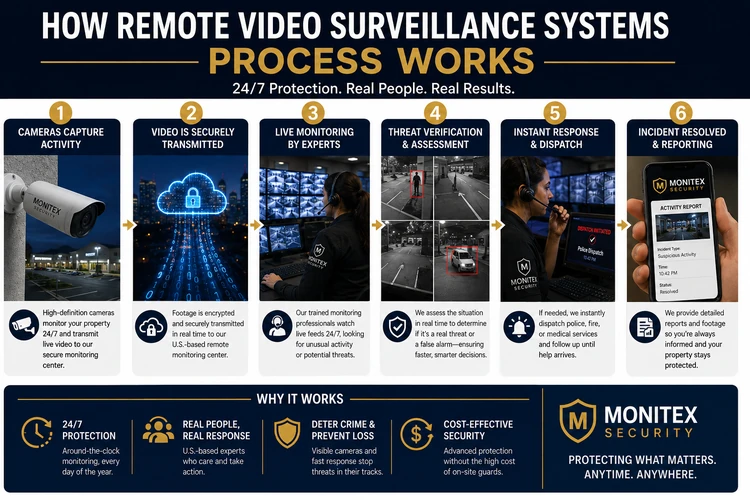
Remote video surveillance systems process live camera feeds through a combination of network-connected hardware, cloud or on-site storage, and trained monitoring agents who respond to threats in real time. Understanding how each layer of this process connects gives you a much clearer picture of what you are actually buying when you invest in professional security coverage.
Key Takeaways
- Remote video surveillance combines cameras, network transmission, storage, and human monitoring into one continuous security loop.
- The process only works well when each component, from camera placement to alert protocols, is properly configured for your specific property.
- Professional monitoring centers add a critical human layer that automated systems alone cannot replicate.
- Perimeter coverage, indoor zones, and entry points each require different camera types and monitoring strategies.
- Response speed depends on how quickly the monitoring center receives, reviews, and acts on a triggered alert.
- Businesses and homeowners across the United States can now access enterprise-grade surveillance without on-site security staff.
What Actually Happens When a Camera Detects Something
Most people assume a security camera just records footage. The reality is more layered than that. When a camera detects motion or crosses a defined trigger threshold, a chain of events begins almost immediately.
First, the camera captures the event and sends that clip or live stream through your internet connection to a monitoring platform. Depending on your system setup, that platform may be cloud-based, stored on a local network video recorder (NVR), or both. The monitoring center then receives an alert, and a trained agent reviews the footage, typically within seconds.
If the agent confirms a genuine threat, they escalate. That escalation might mean contacting you directly, triggering an audio deterrent at the property, or dispatching local law enforcement. This is the key distinction between a passive recording system and a truly active one.
The quality of your internet connection matters enormously here. A camera transmitting high-definition footage over a weak or congested connection will introduce lag, reduce image clarity, and delay alert delivery. For properties where response time is critical, dedicated bandwidth or a wired ethernet connection to the camera is worth considering, as discussed in detail across the protection insights blog.
The Hardware Layer: Cameras, Encoders, and Network Infrastructure
Before any footage reaches a monitoring center, the right hardware has to be in place. Camera selection is one of the most consequential decisions in the entire remote video surveillance systems process, and it is often where property owners underestimate the complexity involved.
Camera Types and Their Trade-Offs
| Camera Type | Best Use Case | Key Advantage | Key Limitation |
| Fixed IP Camera | Entry points, hallways | Low cost, consistent framing | No pan or tilt capability |
| PTZ (Pan-Tilt-Zoom) | Large open areas, parking lots | Flexible coverage, operator-controlled | Higher cost, mechanical wear |
| Fisheye / 360° | Lobbies, retail floors | Wide coverage from one unit | Distortion at edges |
| Thermal Camera | Perimeters, dark environments | Works without visible light | Less detail than optical |
| License Plate Recognition (LPR) | Driveways, parking gates | Captures vehicle data | Narrow field of view |
Choosing the wrong camera for a given zone creates blind spots that compromise the entire system. For guidance on planning camera placement effectively, camera coverage 101 is a practical resource that breaks down zones, angles, and coverage ratios in plain language.
The NIH’s research on visual recognition systems supports what security professionals have observed for years: image resolution and lighting conditions are the two factors that most directly affect whether a camera is useful as evidence or as a deterrent.
How Footage Gets from the Camera to the Monitor
Each camera on your network connects to either a cloud platform, a local NVR, or a hybrid combination. Cloud storage offers off-site redundancy, meaning footage is preserved even if someone physically damages or removes the camera. Local NVR storage is faster for retrieval but vulnerable to on-site tampering.
For enterprise-grade deployments, many companies now use hybrid systems: cameras write to a local NVR for instant access, while simultaneously sending clips to encrypted cloud storage for backup. This architecture is described in detail by resources like CISA’s physical security guidance, the federal agency responsible for protecting critical US infrastructure.
The Monitoring Layer: What Happens After the Alert Fires
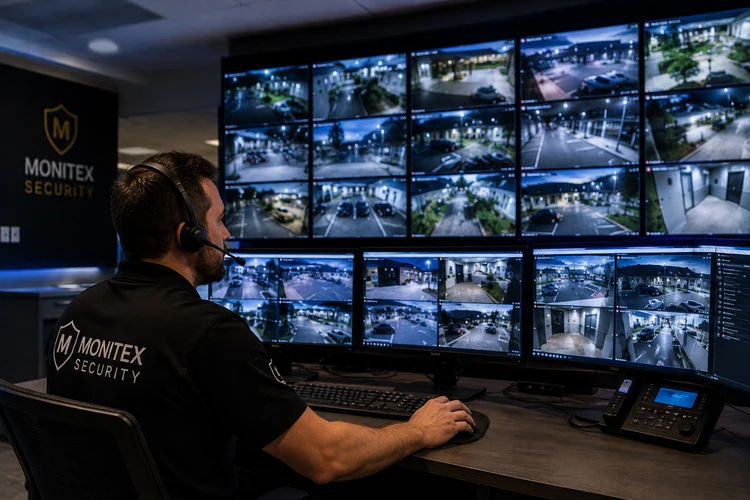
Hardware gets the footage. Monitoring makes the footage useful. This is where professional security companies differentiate themselves from a do-it-yourself camera setup.
Monitex Security, founded in March 2019 and operating a team of 200 security professionals across New York and nationwide, uses trained agents who follow structured escalation protocols when an alert is triggered. This is not an automated system pushing a notification to your phone and leaving the decision entirely to you.
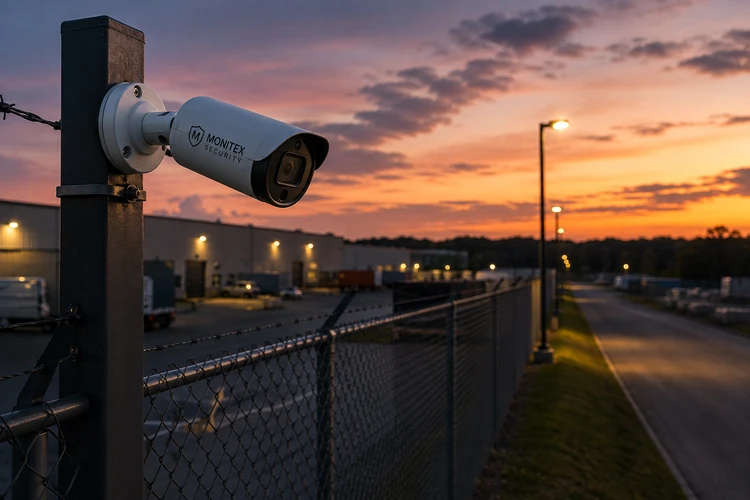
For businesses concerned specifically about boundary intrusions, cctv remote monitoring services for perimeter security outlines how camera networks can be configured to monitor fence lines, loading docks, and exterior zones with defined trigger rules that minimize false alarms.
False alarm management is one of the most underappreciated challenges in professional monitoring. When a camera triggers on a stray cat, a blowing leaf, or a lighting change, the monitoring agent wastes response time and the property owner may face fees from local law enforcement for unnecessary dispatches. Well-configured systems use video analytics to pre-filter alerts before they reach a human agent.
The Role of Audio Deterrents and Two-Way Communication
Modern remote surveillance setups often include audio components. When a monitoring agent confirms suspicious activity, they can broadcast a live voice warning through speakers mounted at the property. This approach, sometimes called “virtual guarding,” has become increasingly common at construction sites, commercial properties, and large retail locations because it interrupts criminal behavior before physical damage occurs.
According to the FBI’s Uniform Crime Reporting resources, property crime remains one of the most prevalent categories of crime in the United States. Audio deterrents combined with visible cameras create a layered psychological barrier that passive recording systems simply cannot provide.
Alarm Integration: Connecting Video to Your Broader Security System
Video surveillance does not operate in isolation for most serious installations. Cameras integrate with alarm systems, access control panels, and sensor networks to create a unified security picture.
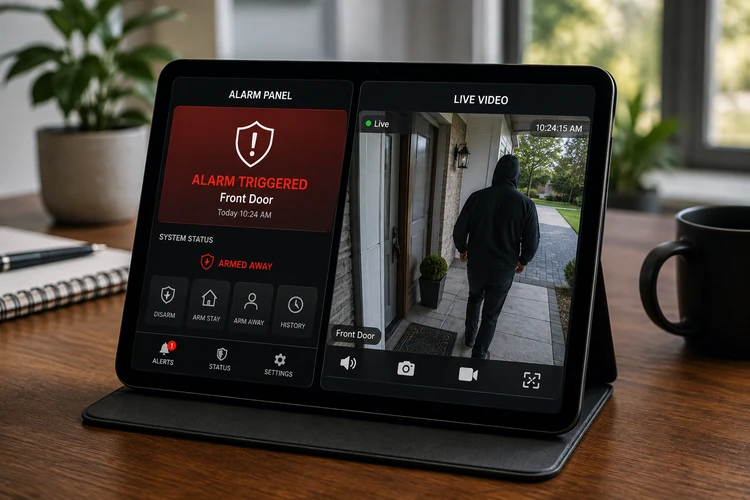
When a door contact triggers, for example, the connected camera at that entry point pulls up automatically in the monitoring dashboard. When a motion sensor fires in a warehouse zone after hours, the camera assigned to that zone begins recording and sending a live clip to the monitoring center. This correlation between alarm events and camera feeds is what makes professional alarm monitoring so much more effective than standalone video or standalone alarms alone.
The Electronic Security Association represents the professional standards body for the US alarm industry and provides certification benchmarks that reputable monitoring companies adhere to.
For residential properties, the same principles apply at a smaller scale. A homeowner using home alarm monitoring can tie their front-door camera, motion-activated floodlight camera, and garage sensor into a single monitored system that gives their monitoring center a complete picture when anything triggers overnight.
Video Analytics: The Technology Behind Smarter Alerts
Raw motion detection is a blunt instrument. Modern remote video surveillance systems use AI-powered video analytics to identify specific object classes, including people, vehicles, and animals, and to distinguish between them.
More advanced analytics engines can flag behaviors rather than just objects. Loitering detection identifies a person who has been stationary in a defined zone for longer than a set threshold. Line-crossing detection triggers when an object moves across a virtual boundary drawn on the camera’s field of view. Object removal alerts fire when a previously present item disappears from the frame.
These tools reduce false alarm rates significantly, which directly improves the quality of the monitoring relationship. When fewer alerts turn out to be false positives, monitoring agents trust the alerts they do receive and respond with greater urgency.
You can find additional context on security technology trends and best practices through the protection insights blog, which covers topics ranging from camera selection to monitoring strategy for properties of all types.
The Mayo Clinic’s guidance on workplace stress is perhaps an unexpected reference here, but it is relevant: research consistently shows that human operators perform better when their alert queues are not flooded with noise. Smarter analytics directly supports better human decision-making at the monitoring center level.
Things to Know
- Camera resolution alone does not determine image quality. Lens type, IR range, and compression settings all affect what you actually see in recorded footage.
- Most municipalities in the United States require law enforcement dispatches to be preceded by verification, which is why human-reviewed monitoring has become the standard for commercial installations.
- Cloud storage costs vary widely. Some providers charge per camera per month, while others offer tiered plans based on total storage volume.
- Cybersecurity is a real concern for IP camera networks. Default passwords and unpatched firmware are the most common vulnerabilities that leave camera systems exposed.
- Not all monitoring centers operate 24/7 with live agents. Verify staffing levels and response protocols before signing any contract.
- Outdoor cameras need weatherproofing rated for your climate. An IP66 rating handles rain and dust, but extreme cold or heat may require additional housing.
Contact For Inquiry: Talk to a Monitex Security Expert About Your Property
If you are evaluating remote video surveillance for a business, construction site, or residential property, the configuration decisions you make at the start will shape the effectiveness of your coverage for years. Contact Monitex Security today to speak with a professional who can assess your property, recommend the right camera types and placement strategy, and connect your video system to monitored alarm infrastructure.
Monitex Security serves clients across New York and nationwide. Reach the team directly at 929-279-4999 or by email at [email protected]. Tell the team your property type and your biggest security concern, and they will take it from there.
Frequently Asked Questions
Q: How does a remote video surveillance system differ from a standard home security camera?
A standard home security camera records footage locally and may send phone alerts, while a remote surveillance system routes live feeds to a professional monitoring center staffed by trained agents.
The key difference is the human layer. A monitoring center agent can verify threats, contact law enforcement, and activate deterrents without requiring you to be at your phone. This makes professional monitoring suitable for commercial properties, large residences, and any site where you cannot always respond personally.
Q: What internet speed do I need for remote video surveillance to work reliably?
Each camera streaming at 1080p typically requires between 2 and 4 Mbps of consistent upload bandwidth, so your total requirement scales with the number of cameras installed.
Beyond raw speed, consistency matters more than peak bandwidth. A connection that fluctuates between 5 Mbps and 50 Mbps will produce more dropped frames and delayed alerts than a stable 10 Mbps connection. Many commercial installations use a dedicated connection or cellular failover to ensure continuous uptime.
Q: Can video analytics really reduce false alarms enough to make a difference?
Yes. Analytics that filter by object class (people vs. animals vs. vehicles) eliminate a large category of nuisance alerts that would otherwise reach your monitoring center.
The improvement is most noticeable in outdoor environments where weather, lighting changes, and wildlife are constant sources of motion. Well-tuned analytics means your monitoring team sees fewer irrelevant alerts and responds faster when something real occurs.
Q: How long is surveillance footage typically stored?
Retention periods vary by plan and provider, but most commercial systems store between 30 and 90 days of footage, either on a local NVR, in the cloud, or both.
Certain industries in the United States, such as retail, finance, and healthcare, may face specific retention requirements under state or federal regulations. Always verify your industry’s compliance standards before selecting a storage plan.
Q: Is remote video surveillance legally permitted for monitoring employees in the workplace?
In the United States, video surveillance of employees in most non-private workplace areas is generally permitted, but specific rules vary by state and require proper notice in some jurisdictions.
Audio recording adds additional legal complexity and is governed by both federal and state wiretapping statutes. Consulting with a legal professional familiar with your state’s privacy laws before deploying any monitoring system that captures audio is a recommended step for any business.
The Bottom Line on the Remote Video Surveillance Systems Process
The remote video surveillance systems process is not a single product you install and forget. It is an interconnected system of hardware, network infrastructure, analytics software, and human monitoring that only performs at its full potential when each layer is properly planned and maintained. Cutting corners on any one component, whether that is camera placement, network reliability, or monitoring quality, reduces the effectiveness of everything else connected to it.
For property owners across the United States who want to move beyond passive recording and into genuinely active protection, the right starting point is a professional assessment. Visit Monitex Security to learn more about how their team structures surveillance solutions for properties of all types, or call 929-279-4999 to start the conversation today.