
Last updated:
Retail shrink is the merchandise a store loses between what its records show and what it actually has, usually stated as a percentage of sales. In the National Retail Federation’s 2023 survey, U.S. retailers put shrink at 1.6% of sales for 2022, about $112.1 billion. Theft by outsiders and employees caused about two-thirds of it, and process errors such as receiving and pricing mistakes caused most of the rest.
Key Takeaways
- Retail shrink is the gap between book inventory and physical inventory, and most retailers report it as a percentage of sales.
- NRF’s 2023 survey put average shrink at 1.6% of sales for 2022, up from 1.4% the year before.
- External theft was the largest single cause at about 36%, employee theft about 29% and process errors about 27%.
- Shoplifting incidents fell 12.4% in 2025, but half of retailers reported more repeat offenders.
- Each cause needs its own fix: live monitoring reduces theft, while counts and receiving checks catch errors.
Retail Shrink in Plain Numbers
Retail shrink is the difference between the inventory a store’s records say it has and the stock actually on its shelves and in its stockroom. Shoplifting, employee theft, receiving and pricing mistakes, damage and vendor fraud all count. Each one turns merchandise into a loss instead of a sale.
In the National Retail Federation’s 2023 National Retail Security Survey, retailers reported average shrink of 1.6% of sales for 2022, up from 1.4% in 2021. Across U.S. retail, that came to $112.1 billion. For one store with $5 million in yearly sales, 1.6% is $80,000 of merchandise that never earned a dollar.
Much of that loss happens where no one is looking: the back door at closing, the loading dock and the lot after hours. That’s why many stores add retail store video surveillance with people watching live. If your counts keep coming up short, Contact for inquiry and we’ll walk through your property with you.
Where Retail Shrink Comes From
Theft causes most retail shrink. In NRF’s survey, theft by outsiders and employees together made up 65% of it. CNBC’s report on the same survey gives the full 2022 breakdown:
| Cause | Share of shrink (2022) | What it looks like in a store |
| External theft, including organized retail crime | 36% | Shoplifting, cart push-outs, after-hours break-ins |
| Internal (employee) theft | 29% | Items rung up for nothing, fake refunds, goods carried out the back |
| Process and control failures | 27% | Short deliveries signed for, price changes missed, damage not written off |
| Unknown and other | 7% | Losses no one can trace |
So the biggest cause of shrink is external theft, and employees account for a little under a third. The three main types are external theft, internal theft and process errors. Group retail theft is its own problem; see how stores handle organized retail theft.
These shares are averages. A grocery store with a busy dock and a mall store with one entrance will lose stock in different ways, so the only breakdown that matters for your budget is your own.
How to Calculate Your Store’s Shrink Rate
Your shrink rate is the value of the stock you can’t account for, divided by your sales for the same period:
Shrink rate = (book inventory − physical inventory) ÷ sales × 100
Book inventory is what your system says you should have after receiving and sales. Physical inventory is what a count finds. Use retail prices for both, and the same dates for all three numbers.
For example, a store’s records show $412,000 of stock at retail. The count finds $405,500, so $6,500 is missing. Sales for the period were $390,000, which makes shrink 1.67% of sales, close to NRF’s average.
Some retailers divide by inventory instead of sales. Either works if you keep using the same one. Count by department, too: a store-wide 1.6% can hide one aisle running at 5%.
Why Shrink Still Matters as Shoplifting Falls
Shoplifting is falling, but the theft that remains is more organized. NRF’s 2025 theft and violence study found shoplifting incidents rose 18% in 2024. Its 2026 study found a 12.4% drop in 2025 and an 8.1% drop in merchandise theft.
The same 2026 study found half of retailers seeing more repeat offenders, 40% more organized retail crime incidents and 37% more walkout or push-out thefts. Fewer incidents, more deliberate ones. For a store, that means fewer casual thefts but more people who come back, or come in groups, knowing exactly what they want. And process errors don’t follow crime trends at all, so a store can lose more to paperwork in a quiet year.
How Stores Reduce Shrink
Match each fix to the cause it targets. A camera won’t catch a mispriced item, and a cycle count won’t stop a break-in.
External theft. Keep staff near the entrances and put high-value aisles in view of a register. Alarm the fire exits, and light the parking lot and the loading area.
Have someone watching the store after closing, when break-ins happen and no one is there to call for help. Our guide to stopping shoplifting covers the sales floor in more detail.
Employee theft. Review exception reports for voids, refunds and no-sale openings each week. Use two people for receiving and for trash runs at closing. Make the policy clear in training, and enforce it the same way for everyone.
Process errors. Check every delivery against its invoice at the dock before signing. Run cycle counts on your highest-shrink categories between full counts. Audit price changes, and log damaged goods the day they’re found.
For the full playbook, see our retail loss prevention strategies.
Where Live Video Monitoring Fits
Live video monitoring cuts the theft part of shrink, not the paperwork part. Trained operators watch a store’s cameras in real time and act while something is happening. They warn people over on-site speakers, call police and send a timestamped report afterward.
It helps most where staff can’t be: the back door and trash area at closing, the dock during deliveries, the parking lot, and the whole building overnight. Retailers with a dock face the same exposure as warehouses and self-storage sites.
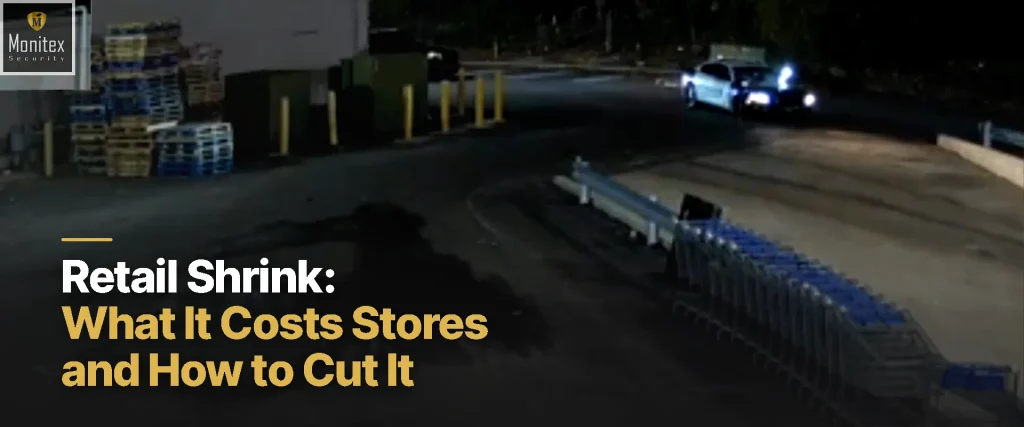
At a grocery store we were monitoring, an operator saw a person walking along the side of the building late at night, after closing, carrying a bag. Our team called police, and officers arrived while the person was still at the back of the store by the stacked pallets. Watch the footage from the grocery store.
Pricing mistakes and short deliveries still need counts and receiving checks. Monitoring covers the rest, around the clock. See how live video monitoring works.
Cut the Shrink You Can See With Monitex Security
Monitex Security puts trained operators behind the cameras your store already has, day and night.
- Operators watch entrances, back doors, docks and parking lots live.
- They warn people over your speakers and call police while it’s happening.
- You get a timestamped incident report with the footage for your loss prevention team.
Contact for inquiry and we’ll walk through your store, dock and lot with you.