
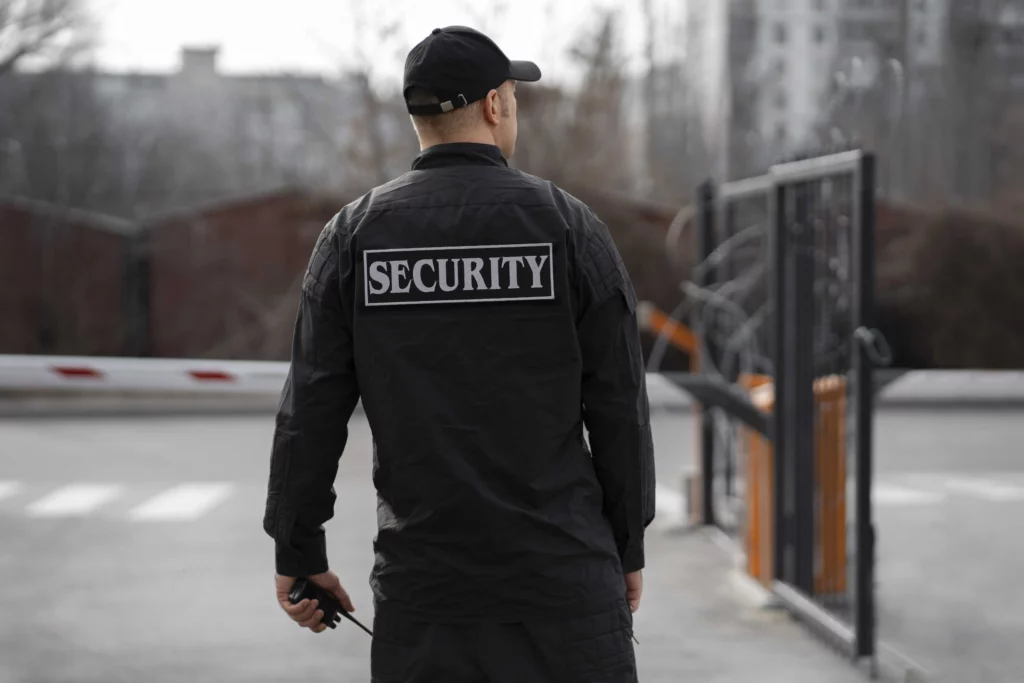
Security guards protect people and property by patrolling, controlling who gets in, watching alarms and cameras, responding to emergencies and writing reports on what they see. Furthermore, their exact duties depend on the site, set out in written post orders from the employer or client. Most states require guards to be licensed, which usually means being at least 18, passing a background check and completing training.
Key Takeaways
- The core duties are the same almost everywhere: patrol, access control, monitoring, emergency response and reporting.
- “Security guard” and “security officer” describe the same job; the U.S. Bureau of Labor Statistics uses both.
- Guards are private employees, not police. Post orders and state law set what they can do.
- Schools, healthcare, retail and hotels are among the largest direct employers of guards.
- One guard covers one spot at a time, and a post staffed around the clock means 8,760 hours a year, which is why many businesses pair guards with live video monitoring.
Security Guard Duties and Responsibilities
About 1.3 million people work as security guards in the U.S., according to the Bureau of Labor Statistics. They stand at front desks, walk construction perimeters, check badges at hospital entrances and watch camera screens through the night. The job looks different at every site, but the security guard duties and responsibilities underneath it are remarkably consistent.
This guide covers what guards do on a typical shift, the skills and licenses the job requires, how duties change by industry, and what business owners should weigh when deciding how to protect a property. If you are weighing guards for your own site, Contact For Inquiry and we’ll help you compare options.
What Do Security Guards Do?
Security guards protect property from theft, vandalism and other illegal activity. The BLS lists their typical duties as:
- Patrolling the property and conducting security checks over a set area
- Controlling access for employees, visitors and vehicles
- Monitoring alarms and video surveillance systems
- Enforcing the property’s rules
- Responding to emergencies and contacting police, fire or ambulance services
- Deterring criminal activity by being visible
- Writing reports on what they observed while on duty
On a real shift, those duties follow a rhythm. At the start, a guard reads the log from the previous shift and checks equipment such as radios, keys and the camera system. During the shift, they patrol on a set route or stay at a fixed post, handle visitors and deal with anything unusual. At the end, they write up incidents and hand over to the next guard.
What a guard does at a given site is spelled out in post orders: written instructions covering patrol routes, who may enter, who to call and what to do in an emergency. Good post orders are specific to the site; vague ones are a common reason guards miss things.
Security Guard vs. Security Officer
There’s no practical difference. The BLS notes that security guards are “also called security officers,” and many companies use “officer” for the same role. The real distinctions are unarmed versus armed guards, and stationary guards who hold a post (such as a lobby desk or gatehouse) versus patrol guards who move around the property.
Security Guard Skills and Licensing
The BLS names four qualities the job depends on: communication (staying clear under stress), interpersonal skills (de-escalating confrontations), observation (spotting anything out of the ordinary) and problem solving (choosing the right action quickly).
Most states require guards to be licensed. Requirements vary by state, but the BLS lists the basics: be at least 18, pass a background check and complete training. Many states recommend about 8 hours of training before an assignment, 8 to 16 hours on the job and 8 hours every year after. Armed guards face stricter screening and firearms training.
One point is easy to miss: guards are private employees, not police. What they’re allowed to do, such as detaining a shoplifting suspect until police arrive, depends on state law and their employer’s rules.
Where Security Guards Work: Duties by Industry
Most guards are employed by guard service companies (58%, per the BLS) and assigned to client sites. Among organizations that hire guards directly, schools, healthcare and retail lead the list. Here’s how the role changes by setting.
Office Buildings
Lobby guards check IDs, issue visitor passes and watch the building’s cameras. After hours, the job shifts to locking up and patrolling floors. See how office building security monitoring covers the hours after the lobby closes.
Residential Buildings
In apartment and condo buildings, guards manage the front door, packages and visitors, and patrol garages and common areas. Learn more about residential building security.
Construction Sites
Construction guards control the gate, log deliveries and patrol the perimeter at night, when equipment, copper and tools are most exposed. Read about construction site security monitoring.
Retail Stores and Shopping Centers
Retail guards protect people, merchandise and cash. The BLS notes they may work with store detectives, detain shoplifting suspects until police arrive and patrol parking lots. See our approach to retail and shopping center security.
Hotels
Hotel guards handle a public lobby at all hours, respond to guest complaints and keep watch on entrances, stairwells and parking. More on hotel security monitoring.
Healthcare Facilities
Hospital guards staff emergency department entrances, manage visitors and help de-escalate tense situations. See healthcare security monitoring.
Schools and Campuses
School guards manage visitor check-in, watch entrances during the day and patrol empty buildings after hours. Learn about school and campus security.

What Business Owners Should Know Before Hiring Guards
For a business owner, the question isn’t what guards do. It’s whether guards alone cover the property. Three limits come up again and again:
- One person, one place. A guard sees what’s in front of them. On a large lot or multi-building site, someone can wait for the patrol to pass.
- Around-the-clock cost. Guards earned a median $38,020 a year in May 2025 (BLS). Staffing one post every hour of the year takes 8,760 hours, more than four full-time schedules before overtime, sick days and agency margin.
- Long night shifts. The BLS notes that guards often watch multiple screens for long periods and that night shifts are common. Attention is hardest to hold exactly when sites are emptiest.
None of this means guards aren’t worth it. A visible person at a front desk or gate does things a camera can’t. It means many businesses get better coverage by combining people on site with people watching remotely.
Where Live Video Monitoring Fits
Live video monitoring puts trained agents behind your cameras around the clock, including nights, weekends and holidays. Instead of one guard walking one route, an agent sees every camera at once.
When something happens, the agent reviews it, warns intruders through on-site speakers, alerts your contacts or dispatches emergency services. Every event is logged with a time stamp and a video clip, much like a guard’s shift report.
Many businesses use it in one of two ways:
- Instead of overnight guards, keeping staff on site during business hours only.
- Alongside guards, so one on-site guard has remote eyes on the areas they can’t see.
How Monitex Helps
Monitex Security’s trained agents watch your existing cameras live, every hour of the day. We review your camera layout first, connect your system within days and add speakers where agents need a voice. Our live video monitoring solutions page explains the full process.
Contact For Inquiry for a free consultation, and we’ll help you decide where guards, monitoring or both make sense for your property.