
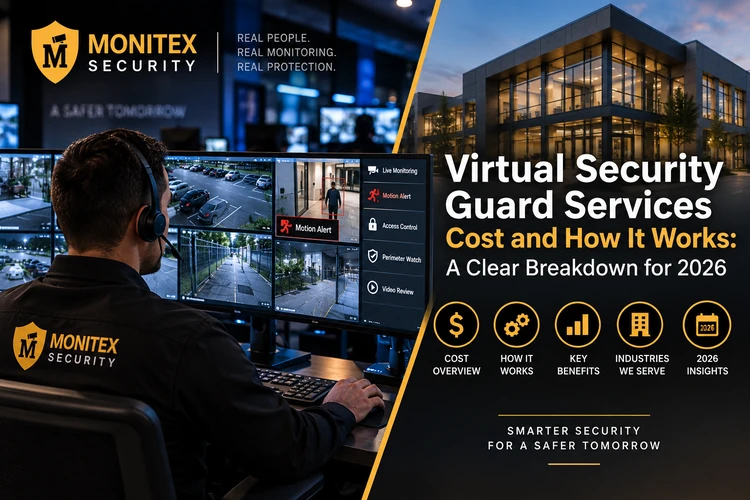
Virtual security guard services cost and how it works as a concept is straightforward: trained operators monitor your property remotely using cameras, AI-assisted software, and real-time communication tools, typically at a fraction of the price of on-site personnel. For businesses across the United States looking to tighten security budgets without cutting protection quality, this model has become one of the most practical options available in 2026.
Key Takeaways
- Virtual security guard services generally cost significantly less per month than hiring full-time on-site guards, making them accessible for small and mid-sized businesses.
- The technology stack typically includes HD cameras, two-way audio, motion detection, and AI-assisted analytics monitored by live operators.
- Pricing varies based on the number of cameras, hours of monitoring required, and add-on services like remote access control or visitor management.
- Virtual guards can respond to incidents in real time by issuing verbal warnings, alerting local law enforcement, or contacting property management.
- These services are scalable, meaning you can expand coverage as your property or business grows without significant infrastructure changes.
- Partnering with an established provider ensures you get trained professionals, proven protocols, and 24/7 accountability.
What Virtual Security Guards Actually Do
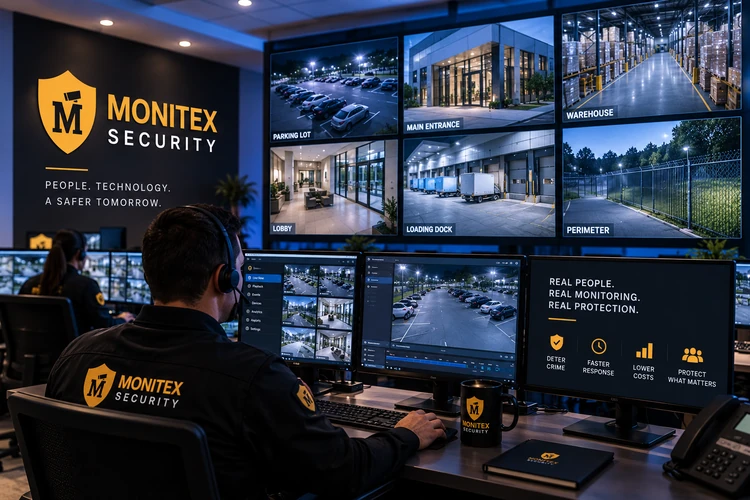
Before examining virtual security guard services cost and how it works in terms of pricing, it helps to understand exactly what you are paying for. A virtual security guard is not simply a passive camera recording footage for later review. Instead, it is a live or AI-assisted operation where trained personnel actively watch your site in real time.
Here is what a typical virtual guard operation looks like in practice:
- Live monitoring: Operators watch camera feeds during scheduled hours or around the clock, depending on your contract.
- Verbal deterrence: When a trespasser or suspicious individual is detected, the operator uses two-way audio speakers to issue a verbal warning. This alone stops the majority of low-level incidents before they escalate.
- Incident escalation: If a warning is insufficient, operators can dispatch local police, contact on-site personnel, or alert property management immediately.
- Access verification: In facilities with entry points, operators can verify visitor identity and control gate or door access remotely through remote access control solutions that are particularly valuable for multi-tenant buildings or gated communities.
- Visitor management: For residential and commercial buildings, operators can handle guest check-ins, log deliveries, and coordinate with tenants through remote doorman services.
- Post-incident review: Footage from flagged events is reviewed and documented through structured video review and analysis processes, making it available for law enforcement or insurance claims.
This combination of live human judgment and technology-assisted detection gives virtual guarding a major advantage over traditional CCTV systems that record passively and are only reviewed after something goes wrong.
How the Technology Stack Works
The backbone of any virtual guard operation is its technology, and without the right infrastructure from a provider like , even the most experienced remote operators cannot do their jobs effectively. Here is what a well-built virtual security system typically involves:
Cameras and Coverage
High-definition IP cameras form the foundation. Modern deployments use cameras with night vision, wide-angle lenses, and pan-tilt-zoom (PTZ) capabilities so operators can track movement across a large area. Camera placement is strategic: entry points, parking lots, loading docks, stairwells, and perimeter lines are the most common focal points.
AI-Assisted Analytics
Artificial intelligence is now embedded into most professional virtual guard platforms. These systems can distinguish between a person and an animal, detect loitering beyond a set time threshold, identify vehicles that do not belong, and flag unusual activity patterns. AI handles the routine filtering so that human operators can focus on genuine threats rather than watching hours of uneventful footage.
Two-Way Audio
Speakers mounted on-site allow the remote operator to communicate directly with anyone on the property. This capability is what separates virtual guarding from passive surveillance. A firm, clear voice from a trained operator telling a would-be intruder that they are being watched and that police have been contacted is extraordinarily effective.
Central Monitoring Software
All feeds, alerts, and communications run through a central platform that the monitoring team accesses. This software logs every event, timestamps alerts, and creates a searchable incident history. For businesses that need audit trails for compliance or insurance purposes, this is a critical feature.
Connectivity and Redundancy
Reliable broadband or dedicated fiber connections ensure that feeds do not drop during critical moments. Reputable providers build redundancy into their systems so that a single network failure does not leave your property unmonitored.
Virtual Security Guard Services Cost: What to Expect
Pricing for virtual security guard services varies based on several factors, and understanding those variables helps you build a realistic budget. While specific figures depend on your provider, location, and setup complexity, the following breakdown gives you a reliable framework.
Key Pricing Factors
| Factor | Impact on Cost |
| Number of cameras | More cameras require more monitoring capacity and higher monthly fees |
| Hours of monitoring | 24/7 coverage costs more than evening-only or weekend monitoring |
| AI vs. human monitoring ratio | AI-primary with human escalation is lower cost than constant human monitoring |
| Add-on services | Remote doorman, access control, and alarm response add to base pricing |
| Installation and setup | One-time costs for hardware, cabling, and integration vary by site size |
| Contract length | Longer contracts typically lower the monthly rate |
Comparison: Virtual vs. Traditional On-Site Guard
One of the strongest arguments for the virtual model is cost efficiency. A full-time, on-site security guard in a major metro area like New York City can cost a business well over $50,000 per year when you factor in wages, benefits, overtime, liability insurance, and management overhead. A virtual security guard setup covering the same property can often be deployed at a meaningfully lower total annual cost, particularly when AI monitoring handles the bulk of routine observation.
For multi-site operators, the savings scale significantly. A single remote monitoring center can supervise dozens of properties simultaneously, spreading the cost of highly trained operators across multiple clients. This is the core economic logic of the virtual guard model.
That said, virtual guarding is not always a complete replacement for physical presence. High-risk environments, locations requiring hands-on response, or sites with complex visitor management needs may benefit from a hybrid approach: virtual monitoring as the primary layer with an on-call or part-time physical guard as backup.
Who Benefits Most From Virtual Security Guard Services
Virtual guarding is not a one-size-fits-all solution, but it fits a remarkably wide range of property types. Here are the categories that tend to see the clearest return on investment:
- Commercial real estate and office buildings: Access control, after-hours monitoring, and visitor management are all well-suited to the virtual model.
- Retail and shopping centers: Parking lot surveillance, deterrence of shoplifting, and after-hours perimeter protection are common use cases.
- Construction sites: These locations are frequently targeted after hours and are difficult to staff with physical guards around the clock. Virtual monitoring with motion-triggered audio warnings is highly effective.
- Multi-family residential properties: Apartment complexes and condominiums benefit from virtual doorman services and lobby access management.
- Industrial and logistics facilities: Loading dock monitoring, vehicle access control, and perimeter patrol are easily handled remotely.
- Healthcare facilities: Patient safety, restricted area access, and after-hours security are all addressable through virtual guard protocols.
For properties in and around New York and across the broader United States, Monitex Security provides tailored virtual monitoring solutions designed around the specific risk profile of each site, and you can explore their total service and support model to understand how ongoing client relationships are structured.
Implementation: What the Setup Process Looks Like
Getting a virtual security system up and running typically follows a predictable sequence. Understanding each phase helps you set realistic timelines and avoid surprises.
1. Site Assessment: The provider conducts a physical or virtual walkthrough of your property to identify coverage gaps, entry points, and risk areas. This shapes the camera placement plan and monitoring protocol.
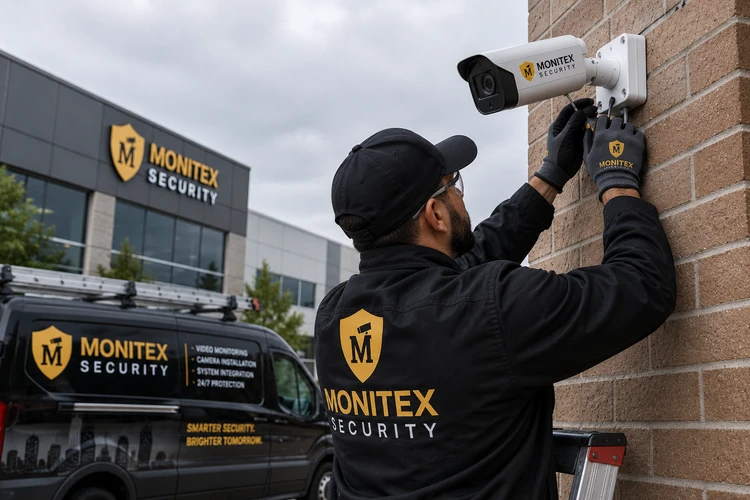
2. Hardware Installation: Cameras, speakers, and networking equipment are installed. Depending on the size of your facility, this can take anywhere from a single day to several weeks for large, multi-building campuses.
3. Software Integration: Camera feeds are integrated into the monitoring platform. AI analytics are configured to your specific environment, reducing false alerts from predictable activity like shift changes or regular deliveries.
4. Operator Briefing: The monitoring team receives a detailed brief on your property, including points of contact, escalation procedures, and any site-specific considerations.
5. Go-Live and Testing: The system goes live with a testing period during which response protocols are verified and any camera blind spots or technical issues are addressed.
6. Ongoing Monitoring and Reporting: From this point forward, your property is monitored according to the agreed schedule, and the protection insights blog from Monitex Security covers many of these implementation considerations in greater depth, offering practical guidance for property managers and business owners navigating this transition.
Regulatory and Compliance Considerations in the U.S.
Virtual security operations in the United States must comply with federal and state-level regulations around surveillance, data privacy, and security licensing. Requirements vary by state, and providers operating in New York, for example, must hold appropriate licenses under New York State Department of State regulations governing security services.
Property owners should also be aware of the Electronic Communications Privacy Act provisions that apply to audio recording in shared spaces, particularly when two-way communication features are in use. In most commercial and multi-family residential contexts, proper signage notifying individuals that they are being recorded is both a legal requirement and a practical deterrent.
For data storage and incident documentation, the National Institute of Standards and Technology (NIST) provides cybersecurity frameworks that reputable security providers use as a baseline for protecting client data and video archives.
Healthcare facilities must also consider HIPAA compliance when deploying surveillance systems in or near patient care areas, ensuring that video feeds do not inadvertently capture protected health information.
Partnering with a licensed, experienced provider takes much of this compliance burden off your plate. Monitex Security, founded in March 2019 and operating with a team of over 200 professionals, has built its operational model around meeting these regulatory standards across New York and nationwide deployments.
How Virtual Monitoring Compares to Alarm-Only Systems
Many businesses already have alarm systems in place and wonder whether virtual guarding is worth the additional investment. The distinction is significant. Alarm systems react to an event after it occurs. They detect a broken window, a tripped motion sensor, or an opened door and then send an alert. By that point, the intrusion has already happened.
Virtual guards operate proactively. Trained operators watching live feeds can intervene before a breach occurs, issue deterrence warnings when someone is testing a perimeter, and escalate to law enforcement with real-time visual confirmation rather than an alarm code. According to the Bureau of Justice Statistics, a significant portion of property crimes occur in commercial settings, and the ability to intervene in real time rather than after the fact represents a meaningful shift in protection posture.
Alarm systems and virtual guarding are not mutually exclusive. Many providers integrate existing alarm infrastructure with virtual monitoring platforms, creating a layered system where alarms serve as one trigger source among several that operators can act on.
Monitex Security serves clients across New York and nationwide, offering customized virtual security guard packages built around your property type, risk level, and budget. To speak with a specialist about your specific needs, reach out at 929-279-4999 or email [email protected]. You can also visit to review available services and request a consultation.
Take Control of Your Property Security Today
Your property deserves protection that never clocks out, never calls in sick, and never leaves a coverage gap. Virtual security guard services deliver exactly that, and working with the right provider makes the difference between a system that looks good on paper and one that actually keeps your people and assets safe. Whether you manage a single commercial building or a portfolio of properties across multiple states, Monitex Security has the experience, technology, and trained personnel to build a monitoring solution around your specific needs.
Contact For Inquiry with Monitex Security today and get a straightforward conversation about your property, your risks, and what a tailored virtual guard setup would actually cost you. Call 929-279-4999 or email [email protected] to speak with a specialist who understands both the technology and the real-world demands of keeping properties secure around the clock.
Frequently Asked Questions
Q: How much do virtual security guard services typically cost per month?
Monthly costs vary based on the number of cameras, monitoring hours, and add-on services included in your contract.
There is no single flat rate for virtual security guard services because every property has different coverage requirements. Smaller sites with a handful of cameras and evening-only monitoring will sit at a lower price point than large industrial facilities requiring 24/7 human-assisted monitoring across dozens of feeds. The most reliable way to get accurate pricing is to request a site-specific quote from a licensed provider who can assess your actual needs rather than offering a generic package.
Q: Can a virtual security guard actually stop a crime in progress?
Yes, virtual guards can intervene in real time using two-way audio to issue verbal warnings and simultaneously alert local law enforcement with live visual confirmation.
Unlike a recorded camera that documents a crime after it happens, a live virtual guard operator can speak directly to an intruder through on-site speakers the moment suspicious behavior is detected. This verbal deterrence stops a large percentage of low-level incidents before they escalate into property damage or theft. For incidents that require a physical response, the operator dispatches police with a real-time description of the situation, which is far more actionable than a triggered alarm code.
Q: What is the difference between virtual security guard services and a standard alarm system?
Alarm systems react after a breach occurs, while virtual security guards monitor proactively and can intervene before an incident fully develops.
An alarm triggers when a door is opened, a window is broken, or a motion sensor is tripped. At that point, the event has already happened. A virtual guard watching a live feed can identify suspicious behavior during the approach phase, issue a warning before anyone attempts to enter, and escalate the situation with real-time intelligence. The two systems are not mutually exclusive, and many properties benefit from integrating their existing alarm infrastructure with a virtual monitoring platform for a layered approach to security.
Q: Do I need to replace my existing cameras to use virtual security guard services?
Not necessarily. Many providers can integrate compatible existing cameras into their monitoring platform, though older or low-resolution equipment may need to be upgraded for effective monitoring.
During the initial site assessment, a reputable provider will evaluate your current camera infrastructure and identify which units meet the resolution and connectivity standards required for live monitoring. High-definition footage is essential for operators to make accurate real-time judgments, so cameras that produce unclear images in low-light conditions are typically flagged for replacement. In many cases, a hybrid approach works well, where existing cameras are retained for certain zones and new hardware is added where gaps exist.
Q: Are virtual security guard services legal in New York and across the United States?
Yes, virtual security guard services are legal throughout the United States, provided the provider holds the appropriate state-issued security licenses and the deployment complies with relevant privacy and surveillance laws.
In New York, security service providers must be licensed through the New York State Department of State. Across other states, licensing requirements vary, so it is important to confirm that your chosen provider is properly credentialed in your jurisdiction. Properties must also post appropriate signage notifying individuals that surveillance and audio monitoring are in use, particularly where two-way communication features are deployed. A licensed, experienced provider will handle compliance documentation as part of the onboarding process and keep you informed of any regulatory changes that affect your setup.
The Bottom Line on Virtual Security Guard Services Cost and How It Works
Understanding virtual security guard services cost and how it works is the first step toward making a smarter, more cost-effective decision for your property. The model is built on a combination of live human judgment, AI-assisted detection, and real-time communication tools that together deliver a level of proactive protection that passive camera systems simply cannot match. For most commercial, residential, and industrial properties, the financial case is clear: you get broader, more consistent coverage at a lower total cost than maintaining a full-time physical guard presence.
The key is partnering with a provider that brings licensed operators, proven technology, and a structured onboarding process to the table. Monitex Security has been doing exactly that since March 2019, serving clients across New York and nationwide with a team of over 200 security professionals dedicated to keeping properties safe around the clock. Reach out at 929-279-4999, email [email protected], or visit the website to start a conversation about what the right virtual security solution looks like for your property.